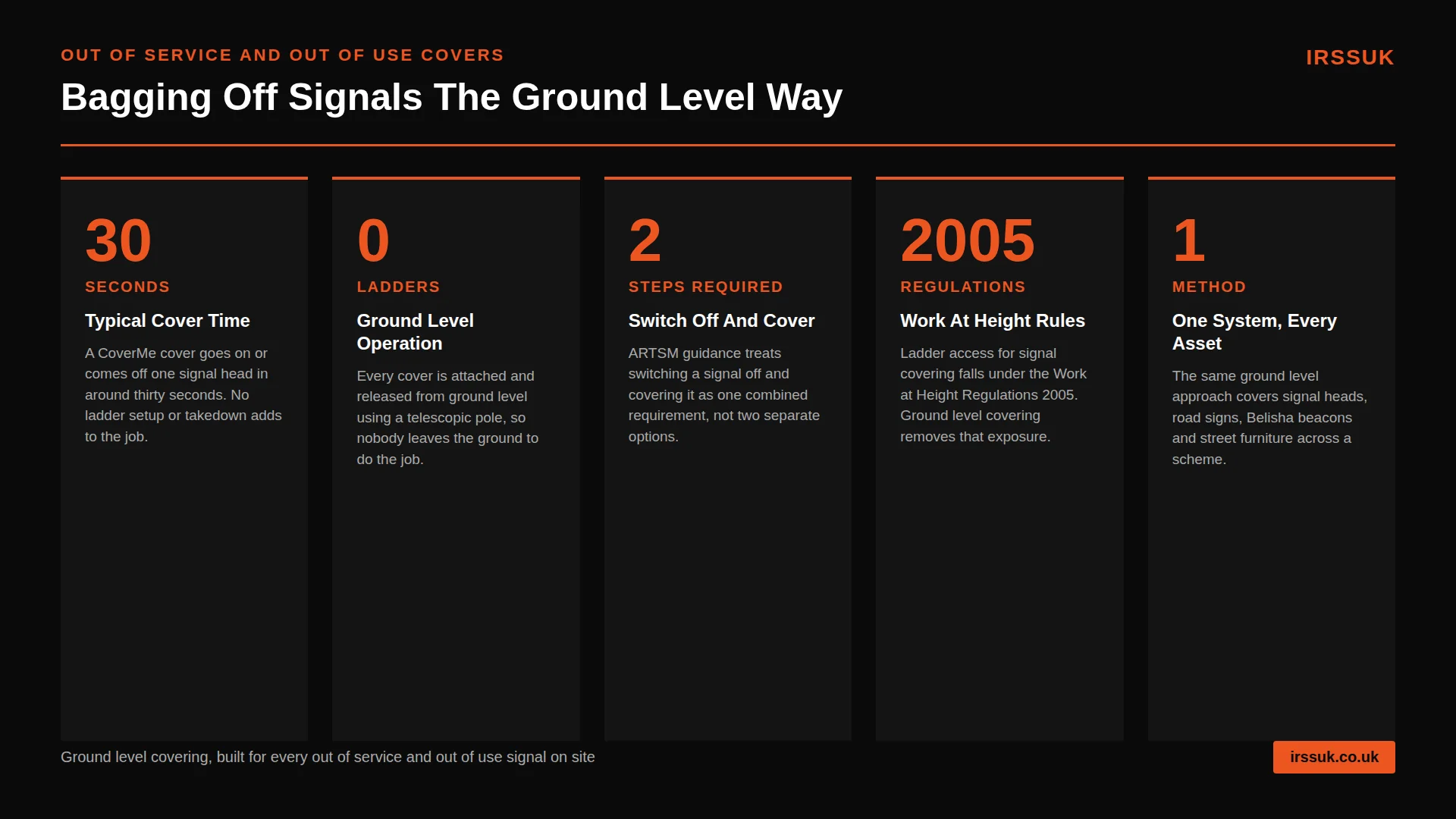
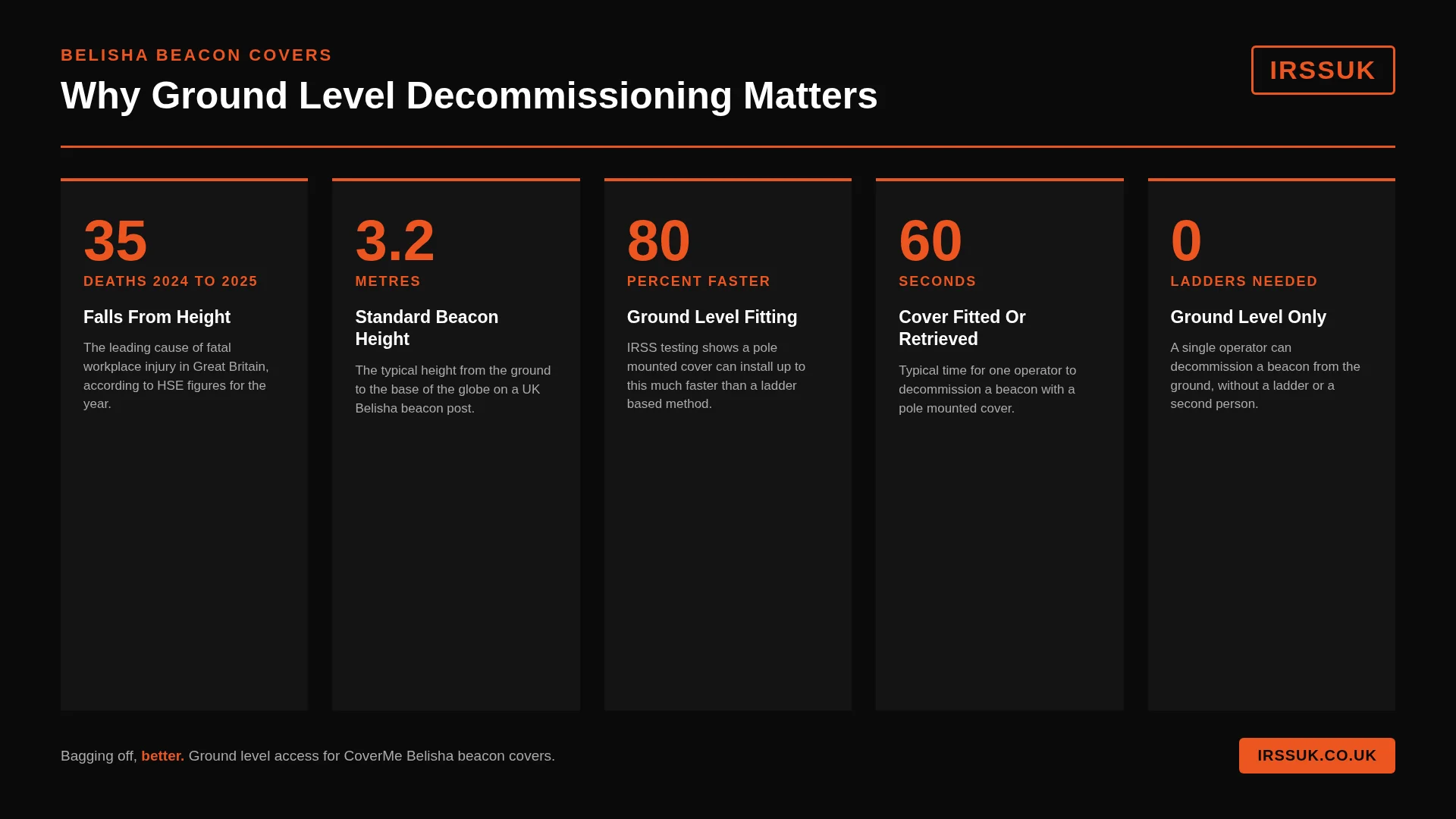
.svg)
In February 2025, ARTSM published updated guidance on bagging and switch off for electrical equipment at works. For UK highways contractors managing Belisha beacons at pedestrian crossings, this guidance has significant practical implications, particularly for mid-post beacon designs where no compliant ground-level bagging solution previously existed. This article explains what the guidance says, what it means in practice, and how the CoverMe mid-post Belisha Beacon Cover from IRSS UK provides the only purpose-built compliant solution currently available.
What Is the ARTSM Guidance on Bagging and Switch Off?
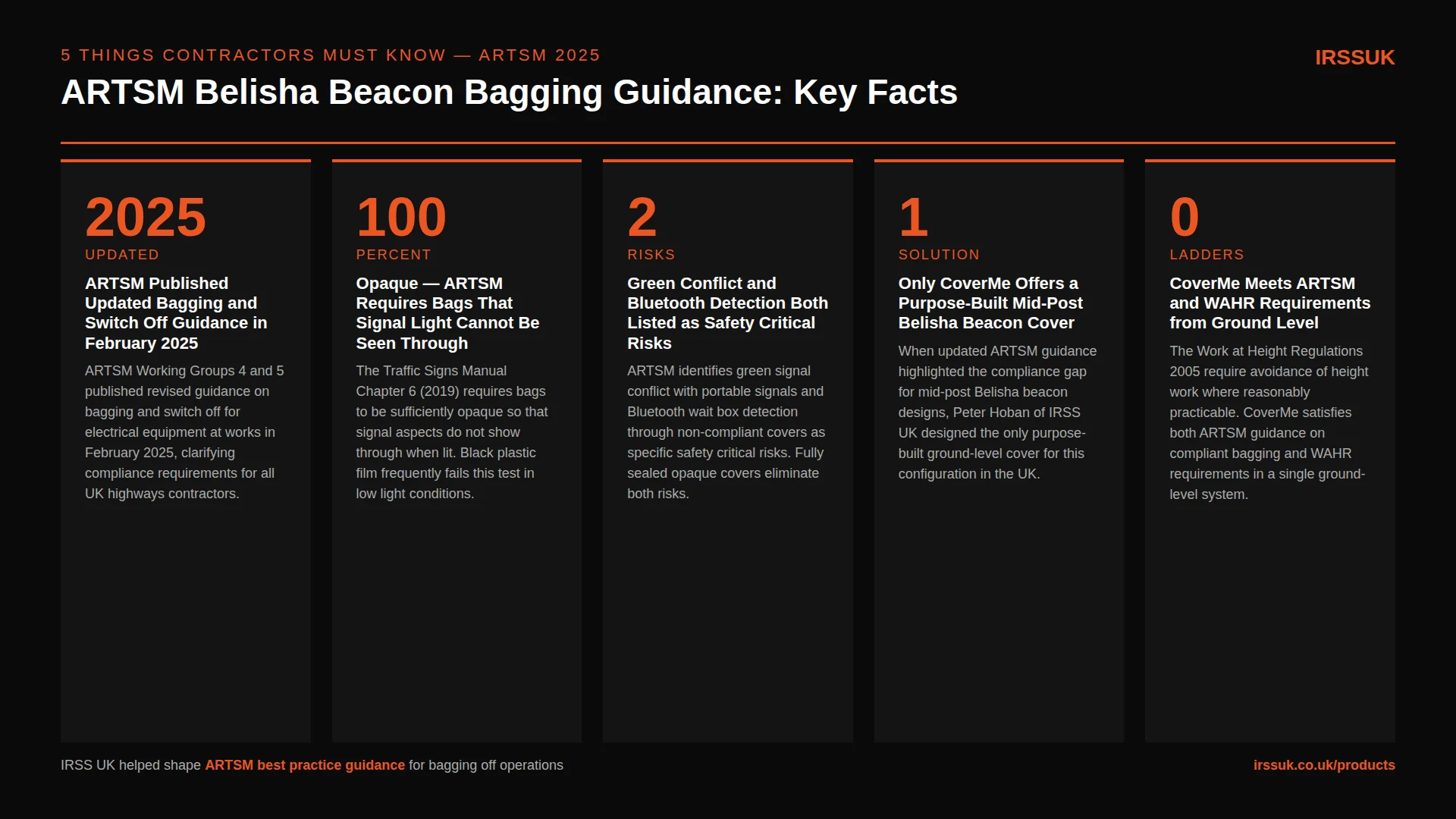
ARTSM, the Association for Road Traffic Safety and Management, published revised guidance on bagging and switch off for electrical equipment at works in February 2025, prepared by Working Groups 4 and 5. The document provides up-to-date information for those undertaking road and street works, covering signalised and non-signalised pedestrian crossings, portable signals, and the safe covering of all electrical equipment at works.
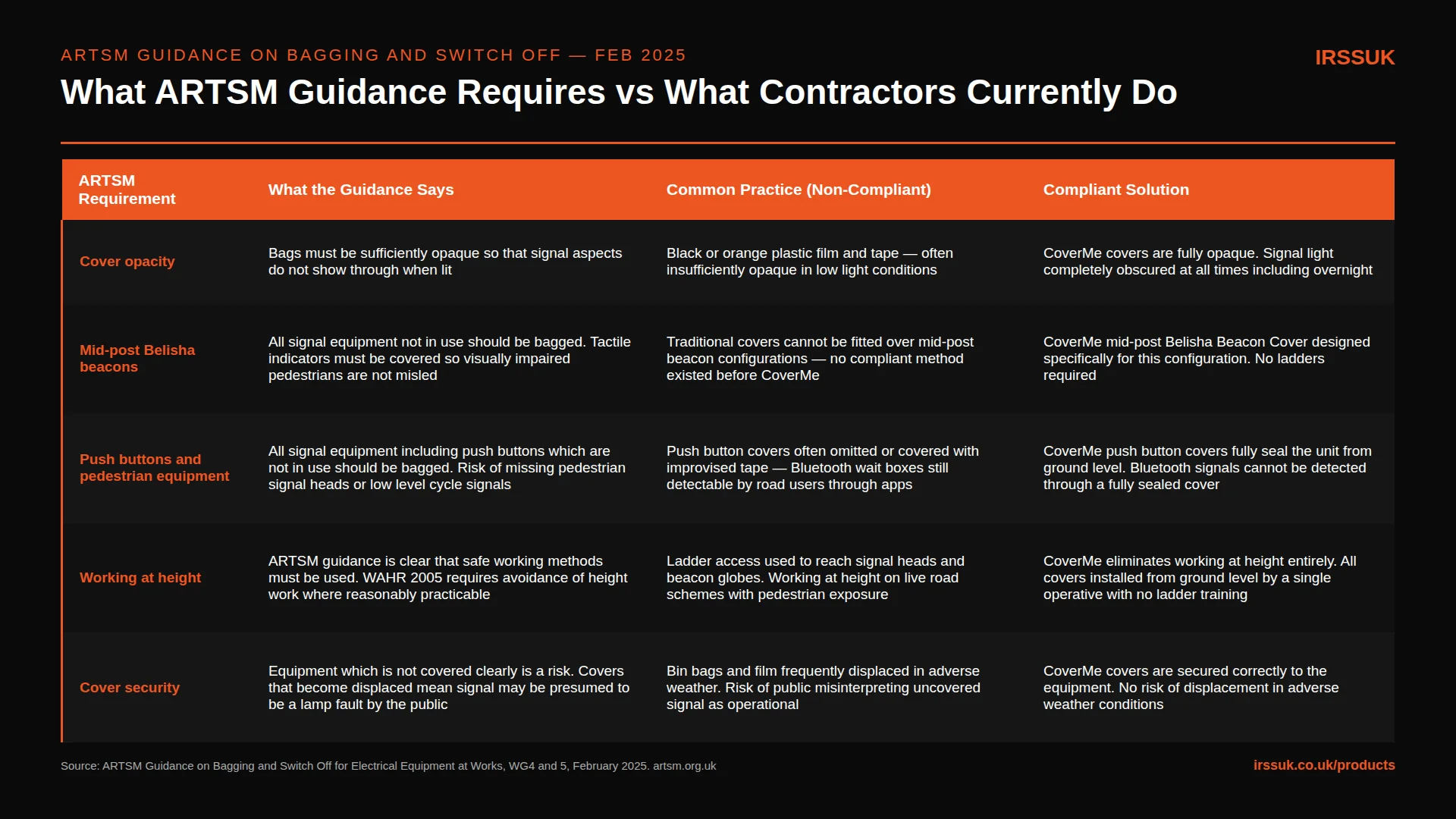
The guidance draws on existing regulatory requirements including the Traffic Signs Manual Chapter 6 (2019), which states that all signal equipment not in use should be bagged, and that bags must be sufficiently opaque so that signal aspects do not show through when lit. It also references the ARTSM Guidance on the Use of Portable Signals (2024), which confirms that where portable signals are used near permanent signals taken out of service, the permanent signalling equipment shall be covered.
IRSS UK worked directly with ARTSM in shaping best practice guidance for bagging-off operations. Peter Hoban, inventor and founder of IRSS UK, has been part of industry conversations about working at height reduction and compliant bagging methods throughout the development of this guidance.
The Mid-Post Belisha Beacon Compliance Gap
For most of the history of Belisha beacons in the UK, the standard design placed the amber globe at the top of a black and white striped post. Bagging off a top-post beacon traditionally required climbing a ladder to reach the globe, working at height on a live pedestrian crossing, in a location where pedestrians and vehicles are present. Traditional bagging covers were designed for this configuration.
In recent years, mid-post Belisha beacon designs have become increasingly common. In mid-post designs, the amber globe is mounted partway down the post, often integrated with a lighting column or fitted using a clamp-on mounting. The spread of mid-post designs created a compliance gap that the ARTSM guidance highlights directly: traditional covers designed for top-post installations cannot be fitted over the mid-post configuration. Contractors were left with no compliant ground-level method for bagging off a design that was rapidly becoming standard.
The ARTSM guidance is also clear on tactile indicators: these must be covered or removed when not in use so that visually impaired and deaf people are not misled, especially where tactile paving has been laid. Mid-post beacon designs are frequently co-located with tactile paving and push-button pedestrian equipment, adding further complexity to the bagging-off requirement.
Safety Critical Risks Identified in the ARTSM Guidance
The February 2025 guidance explicitly identifies several safety critical risks associated with non-compliant bagging practice. These include:
Signals and lights can be seen through bags in low light, creating significant risk to vehicles and pedestrians who may act on a signal they believe to be operational. The guidance notes that black or orange plastic film and tape, the materials most commonly used for improvised covers across the industry, are frequently insufficiently opaque for this purpose.
Green signal conflict is identified as a significant risk where a live signal that has been bagged shows a different indication to a portable signal. This is a direct consequence of non-opaque covers allowing signal aspects to show through.
Bluetooth connectivity in modern pedestrian wait boxes presents a further compliance risk. The guidance notes that Bluetooth equipment which is not switched off can still be detected by road users through an app, and that this is particularly concerning when the road user is a visually impaired pedestrian. A fully sealed, opaque cover eliminates Bluetooth detection risk that a semi-transparent improvised cover does not.
Cover displacement is also flagged as a risk. Where covers become displaced in adverse weather, the uncovered signal may be presumed by the public to be a single lamp fault, leading to dangerous behaviour at junctions and crossings.
How CoverMe Addresses Every ARTSM Compliance Requirement
Peter Hoban designed the CoverMe mid-post Belisha Beacon Cover specifically in response to the compliance gap identified in updated ARTSM guidance. The product is the only purpose-built ground-level cover for mid-post Belisha beacon installations currently available to UK contractors.
CoverMe Belisha Beacon Covers address every compliance point in the ARTSM guidance directly. They are fully opaque, the beacon globe light cannot be seen through the cover at any time, including in low light conditions overnight. They are installed from ground level using the CoverMe extendable pole system, eliminating working at height entirely in line with the Work at Height Regulations 2005. They are secured correctly to the post, with no risk of displacement in adverse weather. And because they fully enclose the beacon equipment, they eliminate the Bluetooth detection risk that non-sealing improvised covers create.
The CoverMe mid-post Belisha Beacon Cover has been supplied to Waterman Aspen, Route 1 Traffic Management, and Clancy for compliant mid-post beacon bagging-off operations, and has been used by Hatton Traffic Management on the HS2 project as a sustainable, fully opaque alternative to single-use bin bags and plastic film.
Common Questions About the ARTSM Belisha Beacon Guidance
When was the ARTSM guidance on bagging and switch off updated?
ARTSM published revised guidance on bagging and switch off for electrical equipment at works in February 2025, prepared by Working Groups 4 and 5. The document updates previous guidance and draws on the Traffic Signs Manual Chapter 6 (2019) and the ARTSM Guidance on the Use of Portable Signals (2024).
What does the ARTSM guidance say about cover opacity?
The Traffic Signs Manual Chapter 6 (2019), referenced in the ARTSM guidance, states that bags must be sufficiently opaque so that signal aspects do not show through when lit. The ARTSM guidance further identifies signals and lights visible through bags in low light as a safety critical risk. Black or orange plastic film commonly used across the industry is specifically noted as frequently insufficiently opaque.
Does the ARTSM guidance apply to Belisha beacons as well as traffic signals?
Yes. The guidance covers all signal equipment including push buttons and pedestrian crossing equipment. It specifically states that tactile indicators should be covered or removed when not in use so that visually impaired and deaf people are not misled. Belisha beacons at zebra crossings fall within the scope of this guidance.
What is the compliant ground-level solution for mid-post Belisha beacons?
The CoverMe mid-post Belisha Beacon Cover from IRSS UK is the only purpose-built ground-level cover for mid-post Belisha beacon installations in the UK. Designed by Peter Hoban in direct response to updated ARTSM guidance, it installs from ground level using an extendable pole, requires no ladder training, and is fully opaque to meet Traffic Signs Manual and ARTSM requirements.
How does IRSS UK relate to ARTSM?
IRSS UK has worked directly with ARTSM in shaping best practice guidance for bagging-off operations across the UK. Peter Hoban has been involved in industry discussions about working at height reduction and compliant bagging methods, giving IRSS UK direct insight into the regulatory direction of the industry before guidance changes are published.
Next Steps for Contractors
If your current bagging-off practice for Belisha beacons relies on single-use bin bags, plastic film, or tape, or if you are operating on sites with mid-post beacon designs and have no compliant cover, now is the time to review your approach in light of the February 2025 ARTSM guidance.
To find out more about the CoverMe Belisha Beacon Cover range for both top-post and mid-post designs, visit the CoverMe Belisha Beacon Covers page or contact IRSS UK directly to request a free sample or site demonstration.