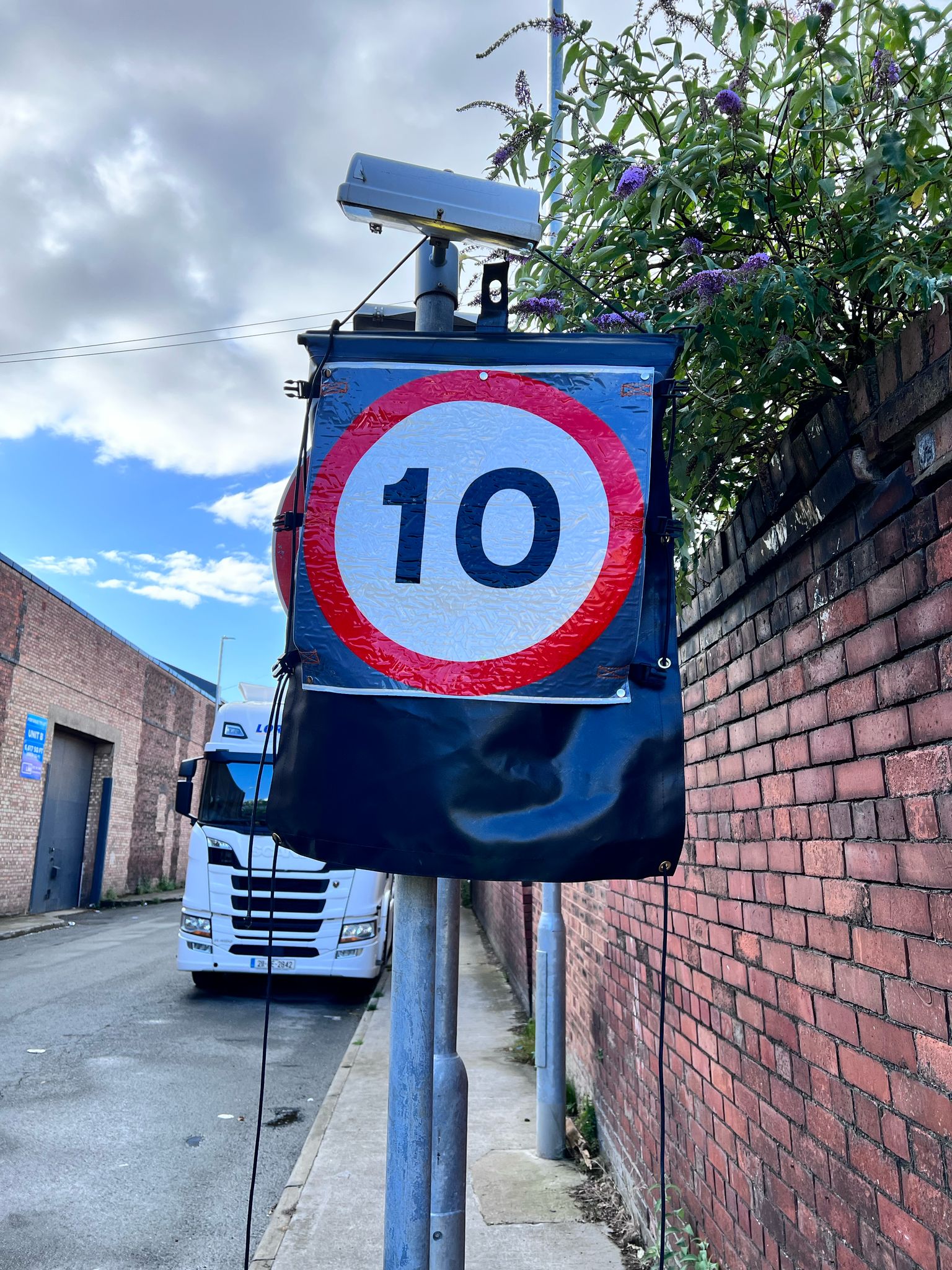
Road sign covers no longer mean ladders, steps or single-use plastic. IRSS reusable covers fit and remove from ground level — cutting deployment time, working-at-height risk and plastic waste on UK highways schemes.
The fastest and safest way to cover a road sign is from the ground with a reusable cover.
Traditionally, sign covering on UK schemes has meant an operative on steps or a ladder, wrapping the sign face in plastic sheeting and tape — repeated across hundreds of signs on a single scheme, and binned after every use. This page explains when and why signs are covered, what the traditional approach really costs in risk, time and waste, and how ground-level reusable covers change the job.
Signs must show only information that currently applies. Under TSRGD and Chapter 8 signing practice, a sign that does not reflect the live road layout must be covered or removed. Covering is required when:
An uncovered out-of-date sign misleads drivers and can undermine the enforceability of temporary restrictions — covering is a compliance task, not a cosmetic one.
IRSS road sign covers fit over the sign face from ground level — no steps, no ladder. One operative fits or removes a cover in seconds, and each cover is reused across hundreds of deployments. The benefits stack:
Fall risk eliminated — avoided at the top of the HSE hierarchy of control, not managed with equipment
Faster phase changes — covers on and off in seconds per sign, compounding across the scheme
Plastic waste near zero — reusable covers replace single-use sheeting and tape on every cycle
Secure and presentable — engineered fit stays put in wind and weather, no flapping plastic
Read the full working at height guide → or estimate your plastic savings with the Plastic Reduction Calculator.
Reusable sign covers fitted without steps or ladders — seconds per sign, hundreds of deployments per cover.
The flagship pole-deployed signal system — same ground-level principle, used at Heathrow and by councils nationwide.
Crossing beacon covers for upgrade schemes, deployed from the ground.
Signs must only show information that currently applies. When a sign is not yet live, temporarily suspended or awaiting removal, TSRGD and Chapter 8 practice require it to be covered so drivers are not misled. Traditionally that meant plastic sheeting and tape; reusable covers now do the same job without the waste.
With a ground-level reusable cover: one operative fits an engineered cover over the sign face in seconds, without steps or ladders. Removal is just as fast, and the same cover is reused across hundreds of deployments.
IRSS covers are designed for hundreds of cover/uncover cycles, replacing single-use plastic and tape on every phase change — a significant waste and cost saving on schemes with many signs.
If taped plastic tears or blows loose, drivers see a sign that does not apply, which can cause confusion and undermine temporary restrictions. Engineered covers with a secure fit avoid this failure mode in wind and weather.
IRSS reusable sign covers remove the ladder, cut deployment time and eliminate single-use plastic on every phase change. Talk to us about your scheme, or calculate your plastic savings.
Sources: HSE work-related fatality statistics 2024/25 · Work at Height Regulations 2005 · TSRGD 2016 · Traffic Signs Manual Chapter 8
.svg)