.svg)
How to Cover Traffic Lights Without Using Ladders
May 7, 2026 | Peter Hoban | IRSS
Covering traffic lights without using ladders is now standard best practice under the Work at Height Regulations 2005, and a system purpose-built to do exactly that has been deployed on UK highway sites for over a decade.
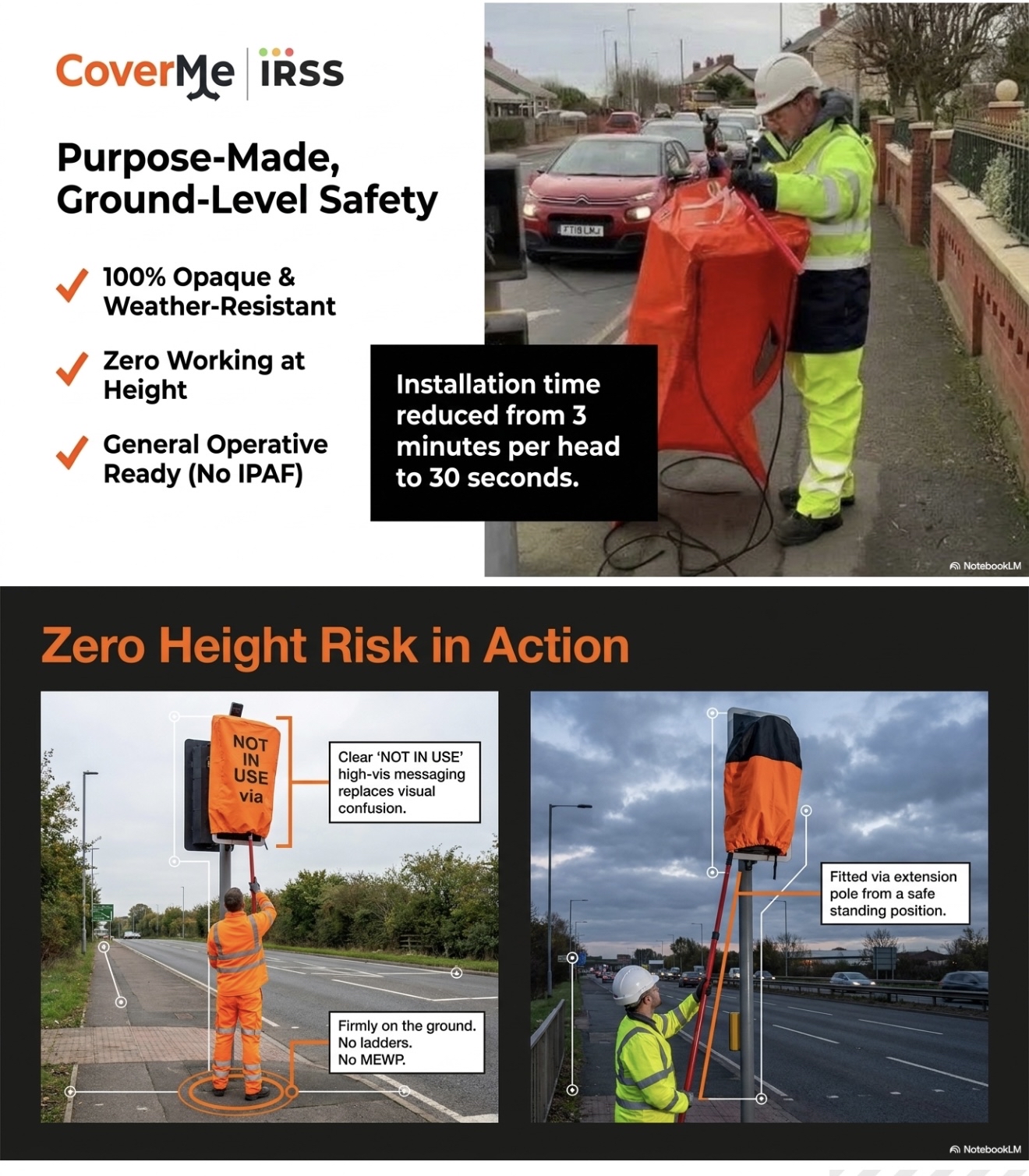
The CoverMe ground-level bagging system from IRSS UK eliminates the need for ladders entirely, allowing a single operative to cover a standard signal head in around 30 seconds using a telescopic extension pole.
This guide sets out how the process works, what the regulations require, and why the industry is moving away from ladders on bagging off tasks.
What Does Covering Traffic Lights Without Ladders Actually Mean?
The traditional approach to bagging off traffic signals involves a ladder, two operatives in most cases, and an exposure time of three to four minutes per signal head at height beside a live carriageway. The alternative is a ground-level system, a purpose-made PVC cover fitted with an eyelet that engages with a hook on an extension pole, allowing the operative to position and secure the cover without leaving the ground.
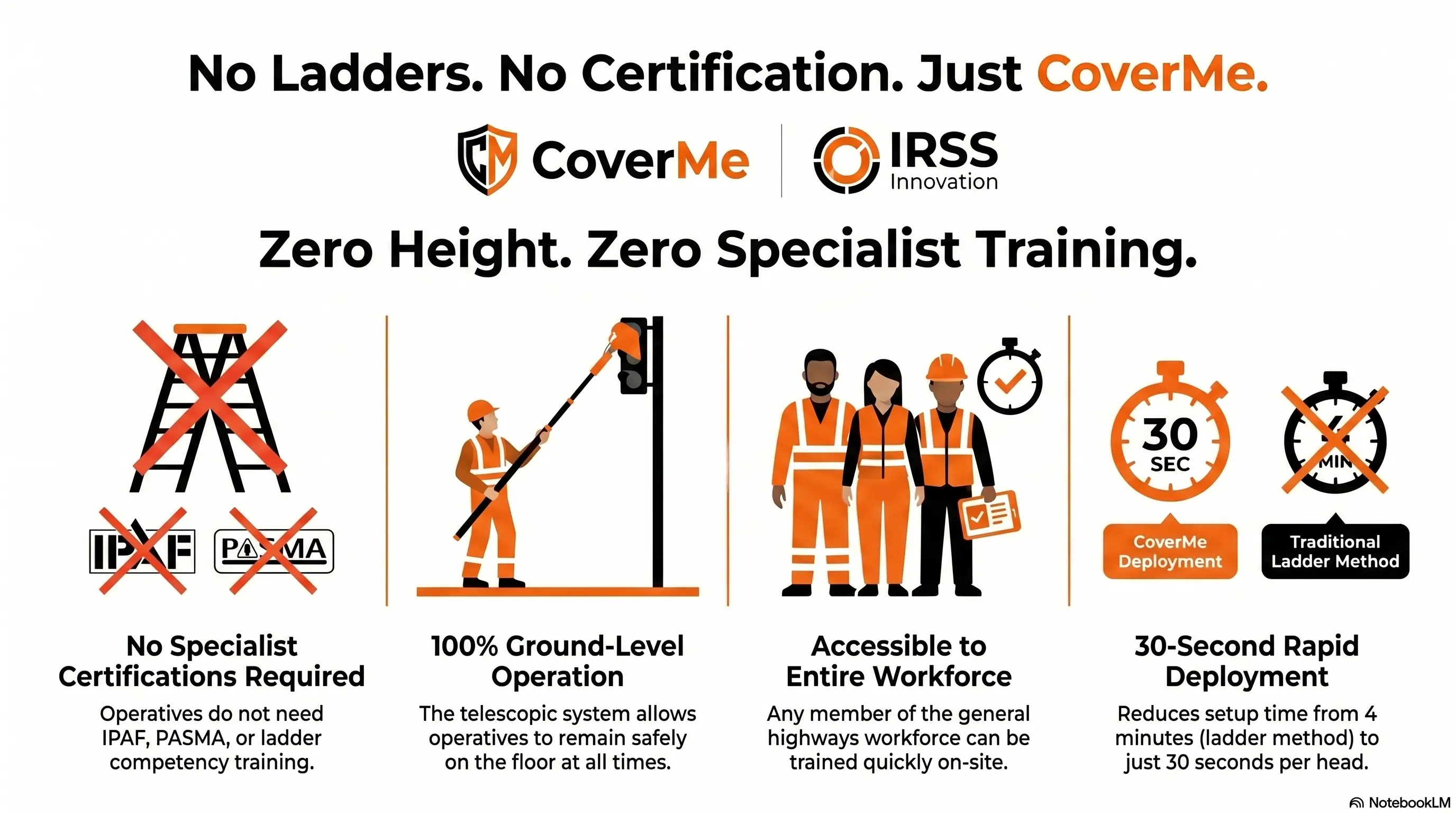
The CoverMe system from IRSS UK works precisely this way. The pole is extended to the correct height, the hook engages the eyelet on the cover, and the bag is lowered over the signal head. Elasticated cords secure it to the pole. The entire operation takes around 30 seconds per head. Removal is faster still — the locking point on the cover disengages cleanly, and the bag drops away without the operative needing to reach above shoulder height.
No ladder. No second operative to foot it. No IPAF certification required. The task is accessible to any member of the general highways workforce.
What the Work at Height Regulations 2005 Require
The Work at Height Regulations 2005 establish a clear legal hierarchy. The first and highest obligation is avoidance: if a task can be carried out without working at height, it must be. Cost or operational convenience is not a valid reason to bypass this step.
For bagging off traffic signals, this is directly applicable. The task can be achieved from ground level using a purpose-made system. Once that system exists and is reasonably available, continuing to use ladders for the same task becomes increasingly difficult to justify in a risk assessment. The HSE’s own guidance specifically cites extension poles as an example of avoidance in practice.
The second level of the hierarchy, fall prevention, is where MEWPs and scaffolding sit. They are safer than ladders but they are not avoidance. Under the regulations, avoidance comes first. Ground-level signal covering achieves avoidance.
How the CoverMe System Works in Practice
Peter Hoban, founder of IRSS UK and inventor of the CoverMe system, designed the product specifically to remove the ladder from the bagging off process on UK highway sites. With over 25 years of direct experience in the highways industry, Peter identified ladder use during signal covering as one of the most persistent and most unnecessary sources of height risk on UK road schemes.
The CoverMe traffic light cover is manufactured in PVC, sized to fit standard UK signal head configurations, and engineered to remain securely in place once fitted. The telescopic pole is made from lightweight GRP, non-conductive and easily transportable by a single operative.
In operational terms, the practical gains are significant:
- Setup time per signal head: reduced from approximately 3–4 minutes (ladder method) to around 30 seconds
- Workforce requirement: one operative, no second person to foot the ladder
- Training requirement: none beyond standard site induction, no ladder or IPAF certification needed
- Traffic management impact: reduced, as no ladder extends into the carriageway or footway
The system has been deployed on schemes including Heathrow Airport traffic management and rail signage projects, where confined working spaces and strict site rules made ladder use impractical or prohibited.
Common Questions
Is it compliant with ARTSM guidance to cover traffic lights from ground level?
Yes. The ARTSM guidance on bagging and switch-off of traffic signals requires that permanent signals not in use are bagged with an appropriately opaque cover. The guidance does not specify that ladders must be used. A purpose made ground level cover that is sufficiently opaque and securely fitted to the signal head fully satisfies the ARTSM requirement. IRSS UK was part of the ARTSM working group that helped in the development of this national best practice guidance.
Do operatives need ladder training or IPAF certification to use CoverMe?
No. Because the system is operated entirely from ground level, there is no requirement for ladder competency, PASMA certification, or IPAF training. The task falls outside the scope of the Work at Height Regulations 2005 entirely, as there is no exposure to height risk. Any member of the general highways workforce can be trained to use CoverMe quickly on site.
Can CoverMe covers be used on all standard UK signal heads?
CoverMe is designed and sized for standard UK traffic signal head configurations. The IRSS UK team can advise on non-standard or older signal types before deployment. A coverage calculator is available to help estimate the number of covers required for a given scheme.
What is the legal position if an operative is injured using a ladder when a ground-level system was available?
Under the Work at Height Regulations 2005, employers have a duty to apply the hierarchy of controls in order. If avoidance was reasonably practicable, as it is when a ground level system is available and accessible, and ladders were used instead, the employer’s position in any enforcement or civil liability action is significantly weakened.
Why Getting This Right Matters
Falls from height remain the leading cause of fatal workplace injuries in the UK. The Health and Safety Executive reports that falls from height consistently account for the largest share of construction sector fatalities year on year. For traffic management companies, the risk on live carriageways is compounded: an operative on a ladder is simultaneously at height and adjacent to moving vehicles.
The regulatory and contractual landscape is also shifting. Principal contractors and local authorities are increasingly requiring evidence that height risk has been avoided, not merely managed, on schemes they procure. Companies that can demonstrate ground-level bagging off as standard practice are in a stronger position at tender stage and carry a more defensible risk assessment in the event of an incident.
Speak to the IRSS UK team to discuss specifying CoverMe on your next scheme.
The IRSS Cover Me range includes:
- Belisha Beacon Covers
- Road Sign Covers
- Street Furniture Covers
- Street Lighting Covers
- Traffic Light Covers
About The Author: Peter Hoban is the founder of Innovative Road Safety Solutions (IRSS) and the inventor of the CoverMe traffic light cover system, a hands-on solution designed to eliminate the need for ladders in traffic management operations. With extensive experience working on live road sites, Peter has a deep understanding of the safety risks and inefficiencies that teams face daily. His work focuses on reducing working at height incidents, improving operational efficiency, and helping organisations meet strict health and safety requirements. Learn more about Peter Hoban and the story behind CoverMe.