.svg)
Every minute a crew spends setting up beside a live carriageway is a minute of unnecessary exposure. Reducing setup time on highway sites is not about cutting corners. It is about removing the steps that were never necessary in the first place. For traffic management teams carrying out bagging off operations, the single biggest source of wasted time is the ladder.
Where the time actually goes on a highway site
Setup time on a traffic management scheme is rarely lost in one place. It accumulates across a series of small delays, each of which feels manageable in isolation but adds up to significant exposure time for operatives working beside live traffic.
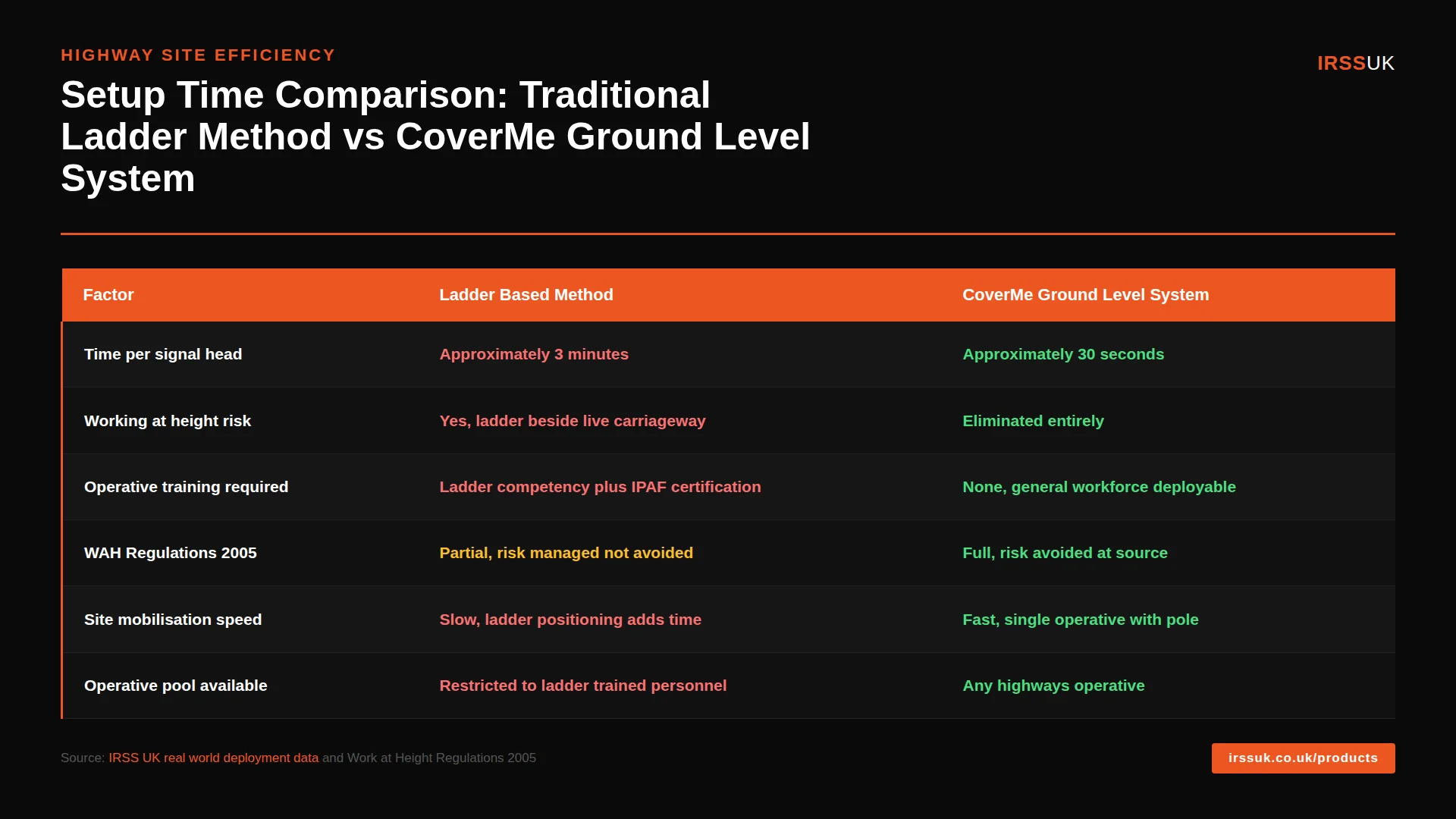
Bagging off permanent signal heads has historically been one of the most time-consuming elements of site mobilisation. Using a ladder on a standard UK signal head requires one operative to position and stabilise the ladder, a second to assist or stand by, and then the process repeats across every signal head at the junction. On a multi-head junction, that can mean 20 minutes or more of ladder work before a single temporary signal is in place.
The Work at Height Regulations 2005 add a further complication. Ladder use beside a live carriageway requires a specific risk assessment, documented competency for the operative, and in many cases IPAF certification. Sourcing a ladder-trained operative for every deployment is a resourcing constraint that many traffic management companies quietly absorb as part of the job. It does not have to be.
The regulation that changes the calculation
The Work at Height Regulations 2005 establish a clear hierarchy of control. Avoiding work at height is the first obligation, not the last resort. Where a task can be completed from the ground, the law expects it to be completed from the ground. Cost and convenience are not valid justifications for defaulting to a higher-risk method.
In the context of bagging off traffic signals, this means that if a ground-level system exists that achieves the same outcome as a ladder, the hierarchy requires it to be used. A method statement that specifies ladder use when an alternative is available and commercially accessible is increasingly difficult to defend in a risk assessment, at tender stage with a local authority client, or in the event of an incident investigation.
CDM Regulations 2015 reinforce this from the design side. The Traffic Management Designer carries a duty to eliminate foreseeable risk at the design stage. Specifying a ground-level bagging method in the method statement satisfies that duty before operatives arrive on site.
How CoverMe changes the setup timeline
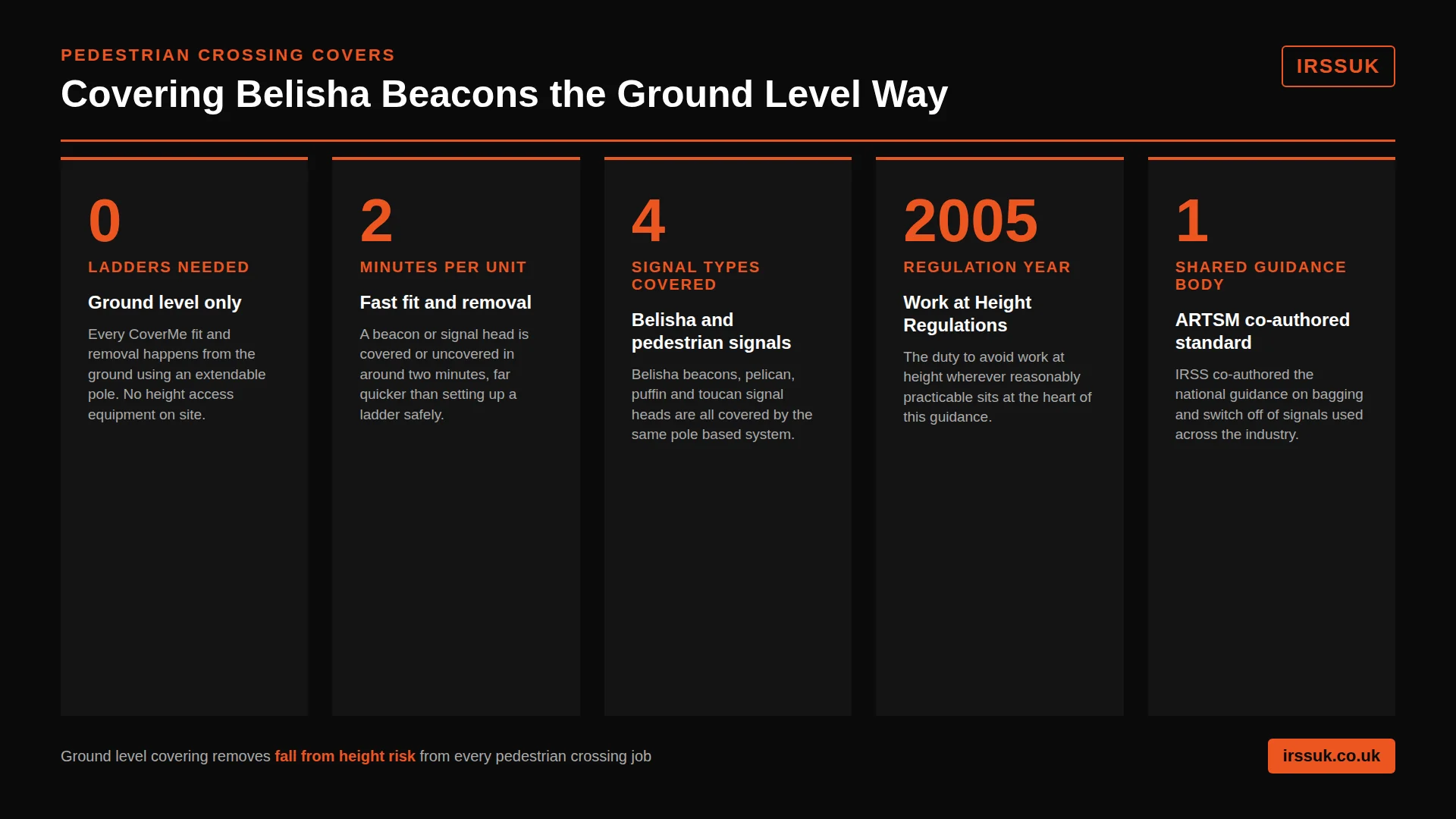
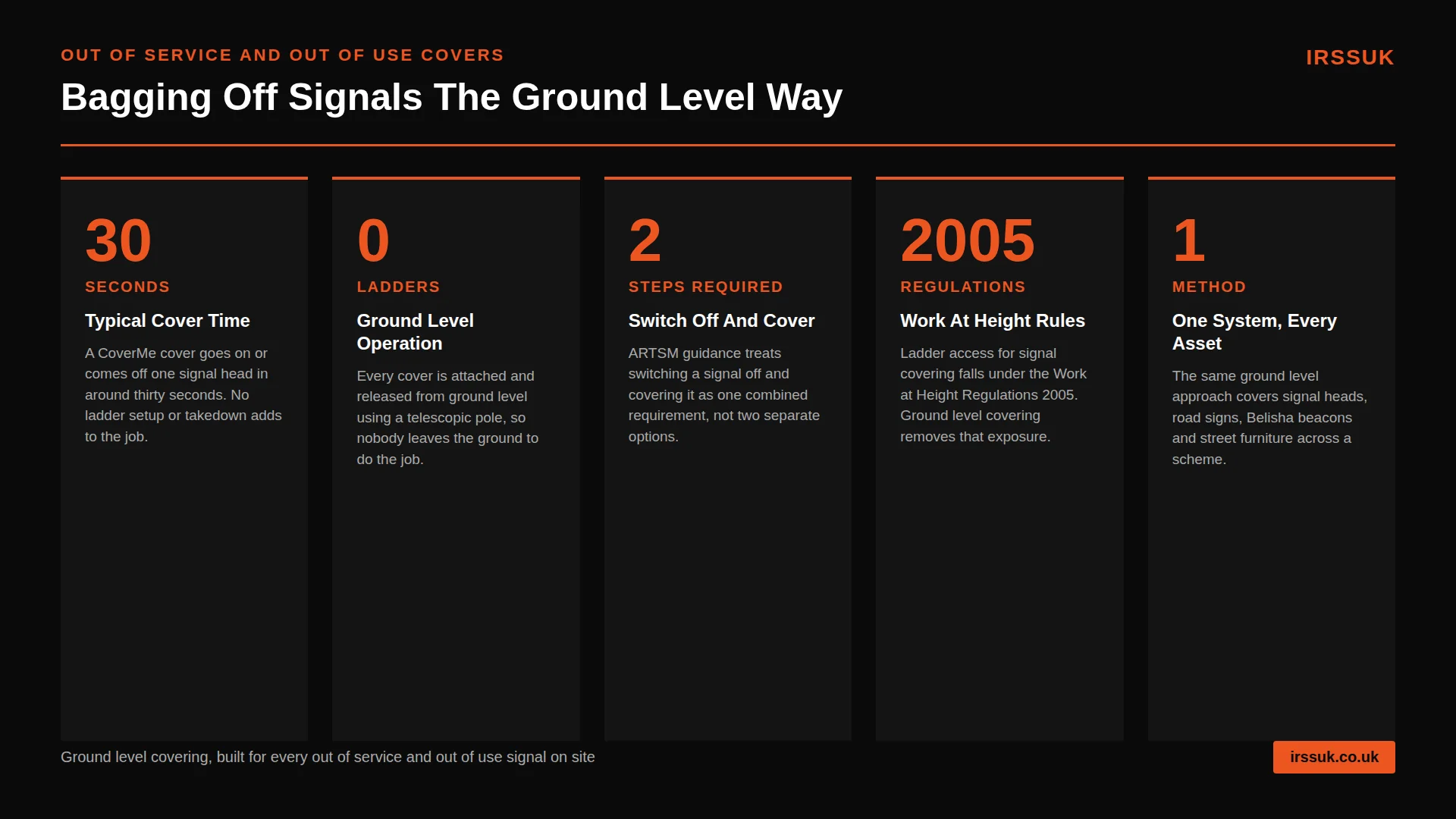
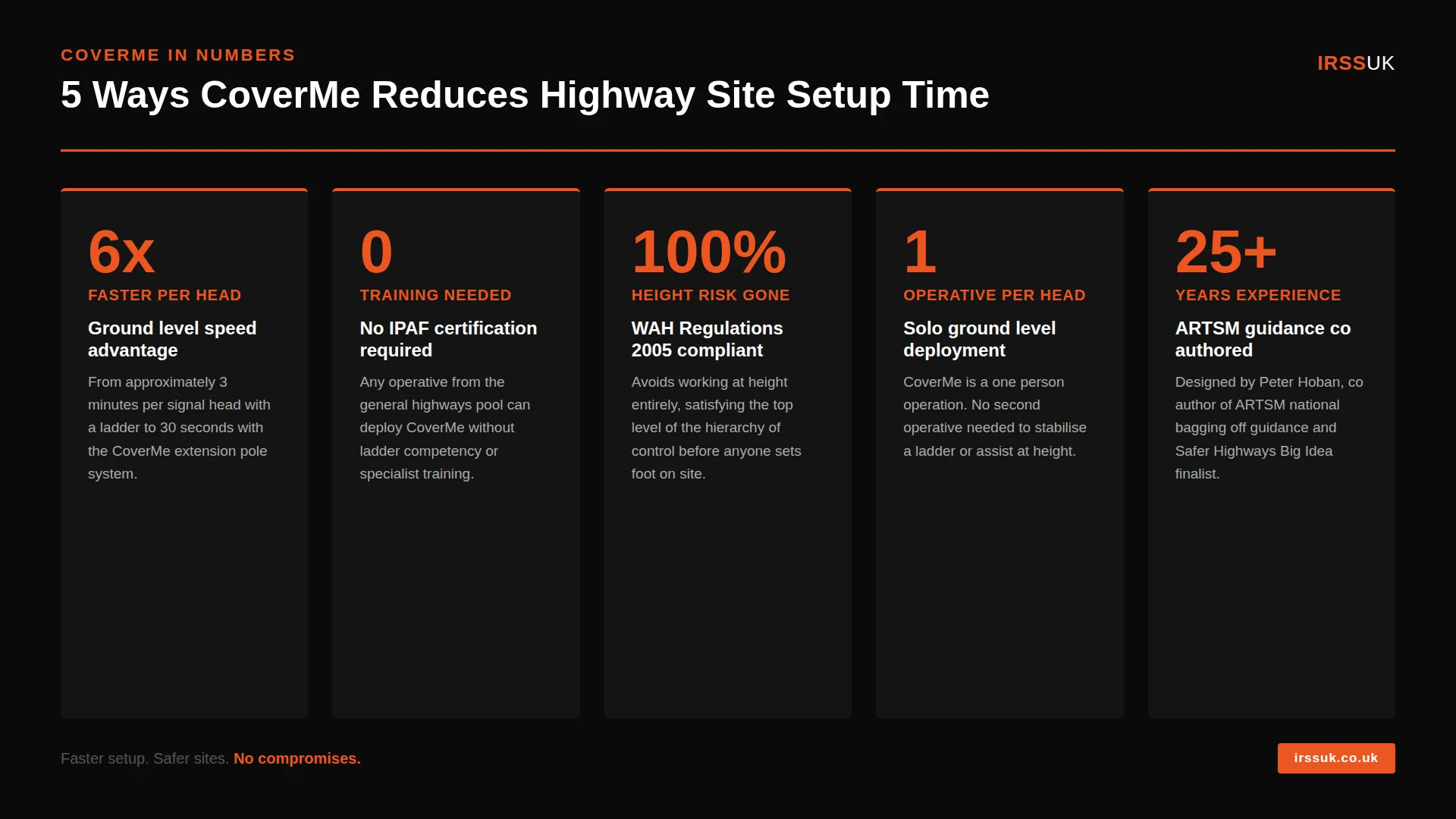
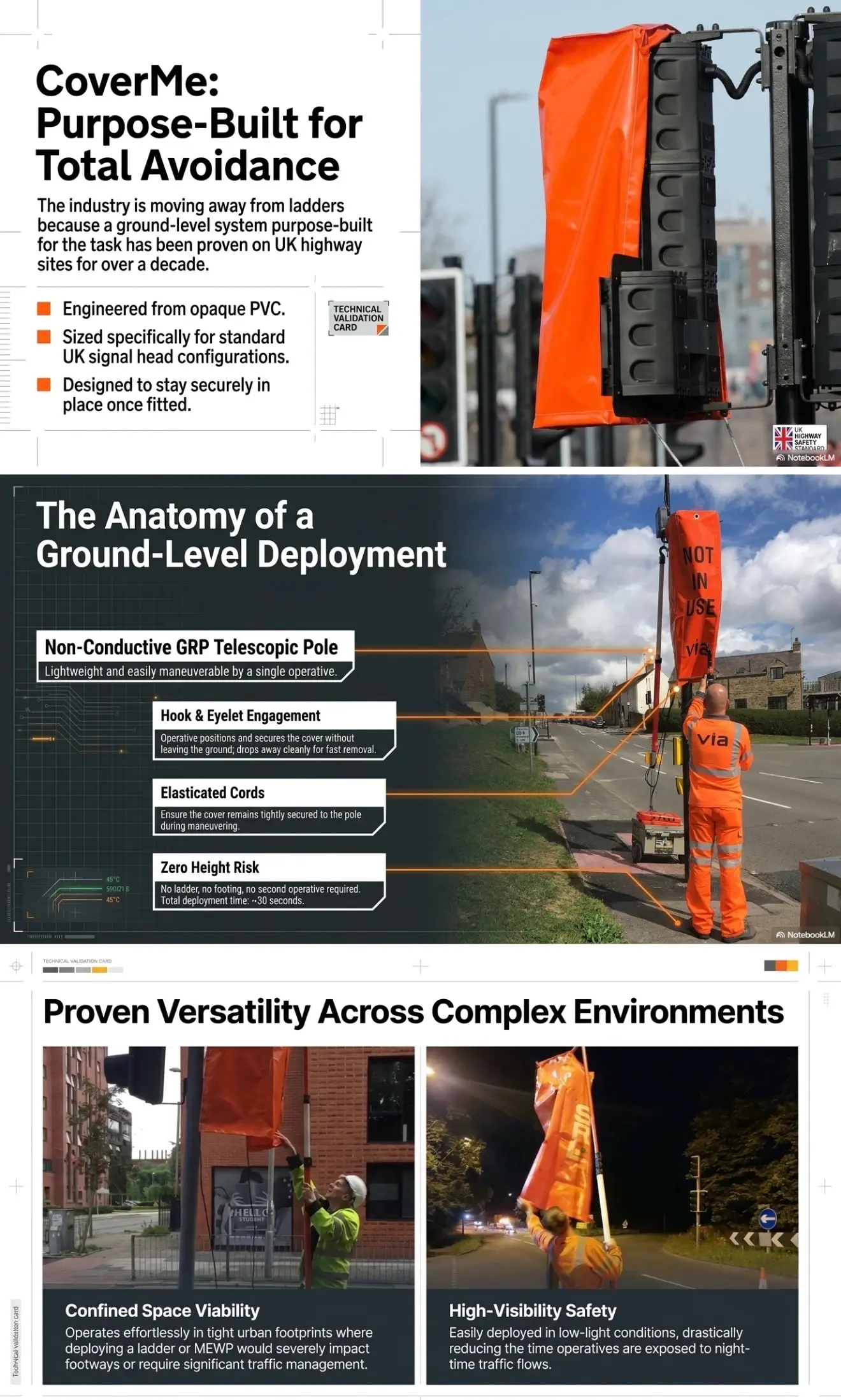
CoverMe traffic light covers from IRSS UK were designed specifically to remove the ladder from bagging off operations. The system uses a patented extension pole mechanism that allows a single operative to fit a purpose-made PVC cover over a standard UK signal head from a standing position on the ground. No ladder. No MEWP. No IPAF certification required.
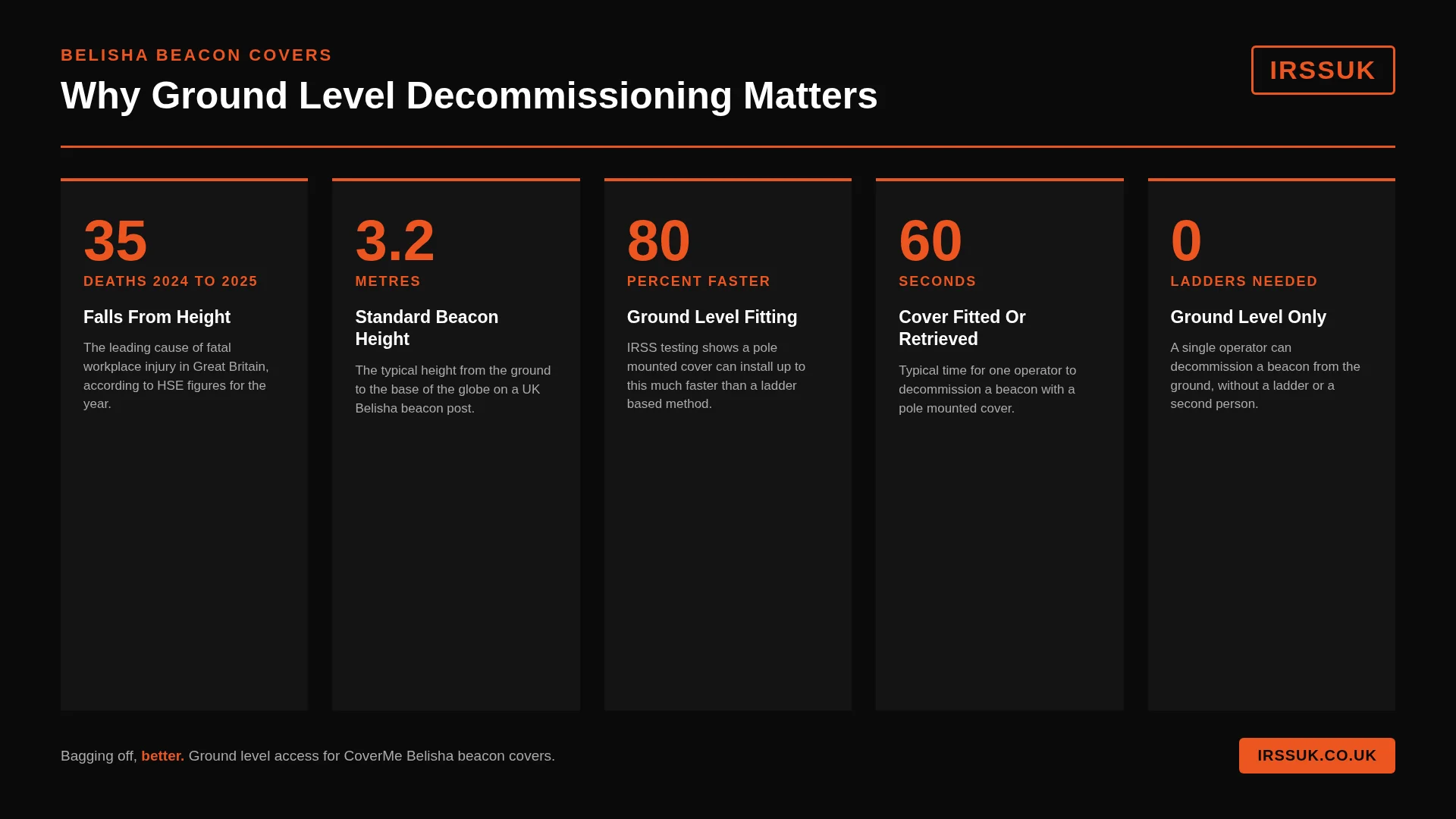
In real-world deployment, the time saving is substantial. A signal head that takes approximately 3 minutes to cover using a ladder-based method takes around 30 seconds with the CoverMe extension pole system. That is a reduction of roughly 80 percent per head. Across a multi-head junction with six or eight signal heads, the cumulative time saving runs to 15 minutes or more on a single mobilisation.
The operational benefits compound further. Because no ladder training is required, operatives from the wider highways pool can carry out bagging off without specialist certification. This removes a common scheduling constraint on site. The crew that arrives can do the job without waiting for a ladder-certified operative to be sourced and deployed separately.
Use the CoverMe calculator to estimate how many covers your next scheme will need and how much setup time you could save.
Real world evidence from UK schemes
The time savings from CoverMe are not theoretical. The Siemens rail scheme case study documents the experience of a team that had used bin bags and shrink wrap for 15 years on railway infrastructure. On switching to CoverMe, the team reported that operatives from the wider highways pool could be deployed without any ladder training requirement, and that the reduction in setup time was the primary reason for adopting the system.
Peter Hoban, founder of IRSS UK, developed the CoverMe system after 25 years working in the traffic management industry. He co-authored the ARTSM national best practice guidance on bagging off traffic signals, which means the product was designed with direct knowledge of where traditional methods fall short and what the regulatory framework actually requires.
Compliance and speed are not in conflict
The assumption that faster site setup requires a trade-off against safety or compliance is one of the most persistent misconceptions in traffic management. In the case of bagging off, the opposite is true. The faster method is also the compliant one.
Ground-level bagging satisfies the Work at Height Regulations by avoiding height risk at source. It satisfies ARTSM guidance on bagging off. It satisfies the CDM duty to eliminate foreseeable risk at design stage. And it reduces setup time by up to 80 percent compared to the ladder-based method it replaces.
For traffic management companies tendering for local authority contracts, this combination matters. Public sector procurement is increasingly focused on supply chain safety performance. A method statement that demonstrates working-at-height elimination rather than working-at-height management is a stronger submission. It also shortens the method statement itself, which reduces pre-works administration time.
Common questions about setup time and compliance
Does reducing setup time mean taking on more risk?
Not when the time saving comes from eliminating an unnecessary step. Replacing ladder-based bagging off with a ground-level system reduces setup time and reduces risk simultaneously. The two are not in conflict. The risk reduction comes from avoiding work at height entirely, which is also what the Work at Height Regulations 2005 require.
Can any operative use CoverMe without specific training?
Yes. CoverMe requires no ladder competency or IPAF certification. Operatives from the general highways workforce can be trained in the use of the extension pole system quickly, without the need to source specialist personnel for each deployment.
Does CoverMe work on all standard UK signal heads?
CoverMe is designed to fit standard UK signal head configurations. IRSS UK can advise on specific signal types and non-standard configurations before deployment. The full product range also covers road signs, Belisha beacons, street lighting columns, and other street furniture that requires bagging off on UK schemes.
How does switching to CoverMe affect method statements and risk assessments?
Positively. A method statement specifying a ground-level bagging system is simpler to write, easier to audit, and more defensible under CDM and WAH legislation than one that specifies ladder use.
What is the cost comparison between CoverMe and traditional methods?
CoverMe covers are reusable across multiple deployments. The per-deployment cost reduces with each use, unlike single-use bin bags or shrink wrap. When the saving in operative time is factored in, together with the removal of ladder hire or MEWP costs, the case for switching is straightforward on any scheme of meaningful size.
The key takeaway
Reducing setup time on highway sites does not require compromise. The fastest method for bagging off traffic signals is also the safest, the most compliant, and the most cost-effective across the deployment lifecycle. Speak to the IRSS UK team to discuss how CoverMe can be specified into your next scheme.
About the author: Peter Hoban is the founder of IRSS UK and inventor of the patented CoverMe system. With over 25 years of experience in traffic management and road safety, Peter co-authored the ARTSM national best practice guidance on bagging off traffic signals. He is a Safer Highways Big Idea finalist and a recognised authority on working-at-height elimination in the highways industry.