.svg)
Bagging off is the process of covering permanent traffic signal heads when they are taken out of service during roadworks or temporary traffic management schemes. It is a legal requirement on every UK scheme where permanent signals are decommissioned, and it exists for one clear reason: to prevent road users from acting on signals that are no longer operating.
If you are new to traffic management, or sourcing solutions for your team, this guide explains what bagging off involves, what the law requires, and why the method used to do it matters as much as the task itself.
Why traffic signals need to be covered during roadworks
When a road or street works scheme requires permanent traffic signals to be taken out of service, those signals continue to be visible to road users. A signal head that is unlit may appear to be a fault. A signal that is lit but not switched off before being covered may still be detectable by pedestrians using apps linked to Bluetooth-enabled wait boxes. Either scenario creates confusion and safety risk for vehicles and pedestrians alike.
Chapter 6 of the Traffic Signs Manual 2019 is explicit on the requirement. All signal equipment not in use must be bagged over or clearly marked as out of use. The bags used must be sufficiently opaque so that signal aspects do not show through when the equipment is lit.
The ARTSM guidance on bagging and switch off of electrical equipment goes further, setting out the specific risks of inadequate bagging: signal bleed through in low light conditions, Bluetooth wait boxes that remain active even when covered but not switched off, and the risk of vulnerable pedestrians being misled by tactile or audible equipment that has not been properly decommissioned.

What bagging off involves in practice
On a standard UK roadworks scheme where permanent signals are switched off, bagging off involves covering each signal head with an opaque cover before temporary signals are deployed. The process runs in a defined order on every site.
- Action Why it matters. Obtain permission from the traffic authority to switch off permanent signals. Legal requirement under ARTSM guidance
- Switch signals to all red, then off. Prevents green conflict with temporary signals
- Cover all signal heads including pedestrian push buttons and low level cycle signals. Opacity requirement under Chapter 6 TSM 2019
- Check that temporary signal positioning is not obscured by the bagging. Road users must see which signals are operational
- Confirm all covered heads are fully switched off. Bluetooth and tactile equipment can remain active if left on
What gets bagged off, not just signal heads
Bagging off applies to all electrical signal equipment not in operation, not just the primary vehicle signal heads. Pedestrian wait boxes must be covered or removed when not in use. Tactile rotating cones and audible signals must be addressed because they still operate when equipment is switched on, creating significant risk for visually impaired and deaf pedestrians. Low-level cycle signals and any pedestrian signal heads at the junction must also be covered. Belisha beacon heads at zebra crossings adjacent to the works must be bagged and switched off.
Regulatory signs attached to traffic signals are a specific exception. These must remain illuminated and uncovered unless a Traffic Regulation Order is in place that negates the sign, because the power supply for regulatory signs is typically isolated from the main signal heads.
The problem with improvised bagging methods
For most of the history of traffic management, bagging off meant finding a bin bag, some tape, and a ladder. Bin bags offer no guaranteed opacity. They tear in cold weather, blow off in wind, and provide no consistent fit across different signal head types and sizes. The ARTSM guidance specifically identifies plastic film and tape as inadequate practice.
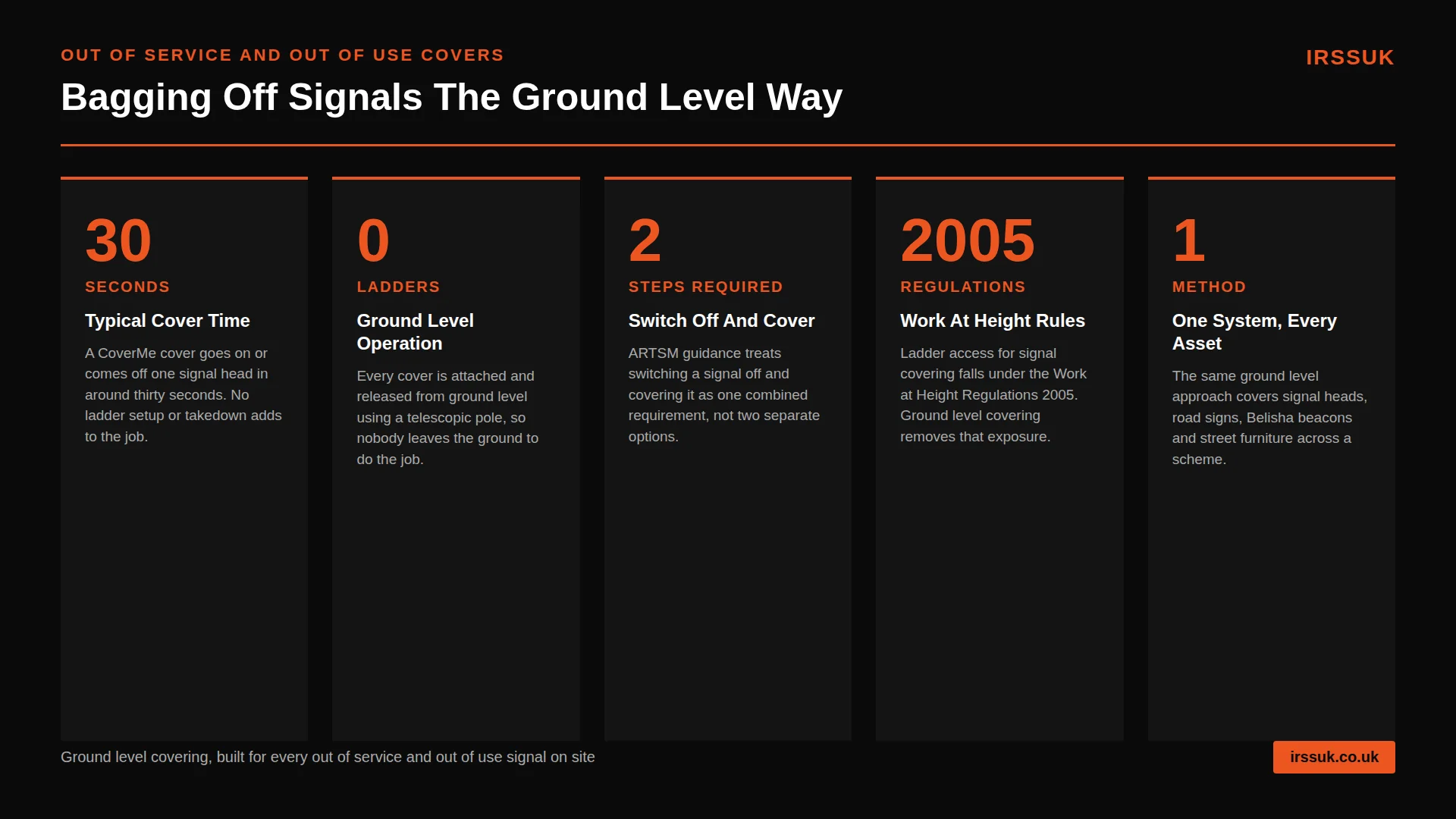
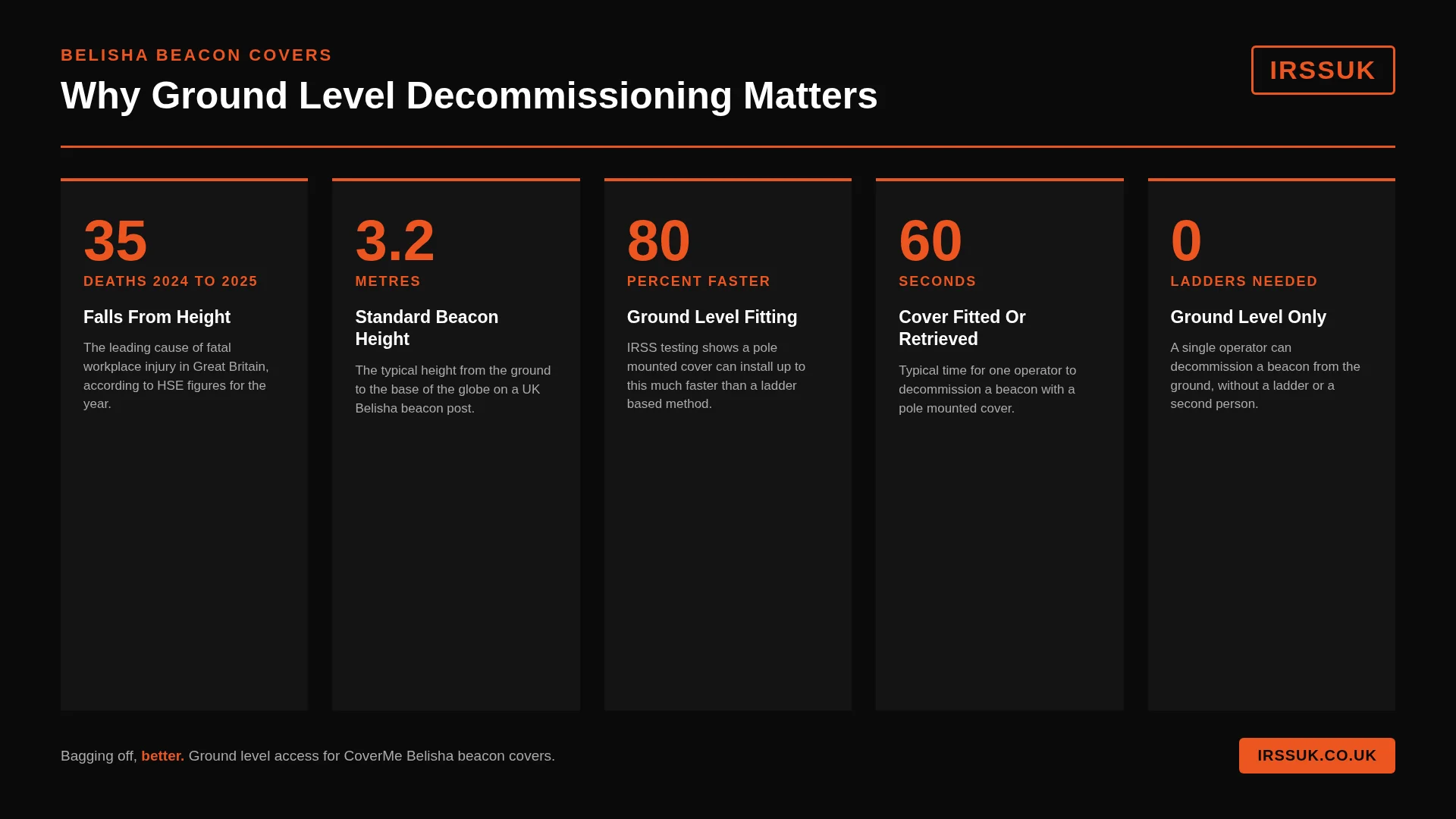
The ladder introduces a separate and entirely avoidable risk. Falls from height remain the leading cause of fatal workplace injuries in Great Britain. The Work at Height Regulations 2005 require that height work is avoided wherever it is reasonably practicable to do so. Where a ground-level system exists that achieves the same outcome, using a ladder instead is difficult to justify in a risk assessment.
The safer method: ground-level signal covers
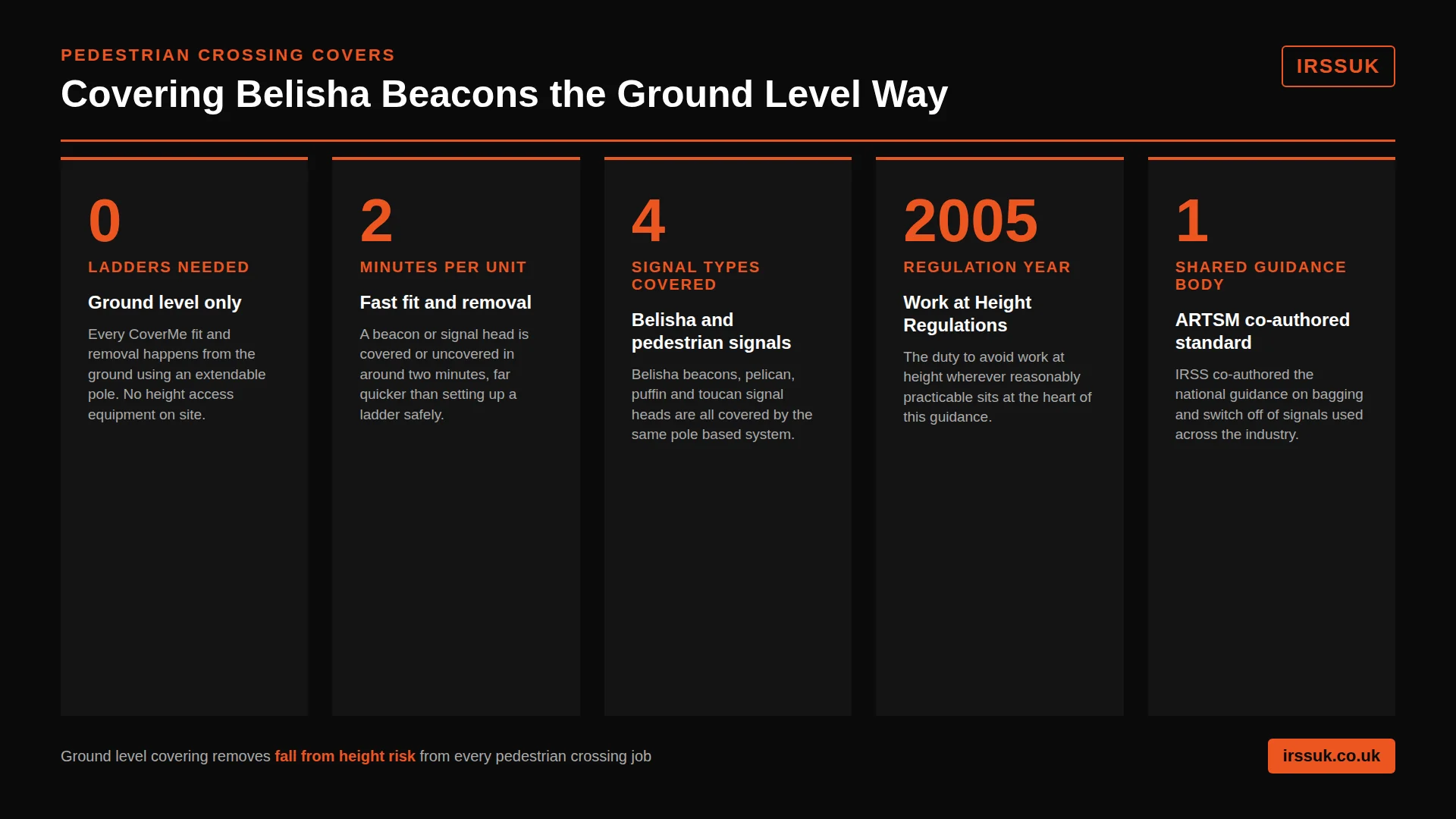
CoverMe traffic light covers from IRSS UK were developed specifically to replace improvised bagging methods with a purpose-made, ground-level system. The cover is fitted over the signal head using an extension pole from a standing position on the ground. No ladder. No MEWP. No IPAF certification required.
Peter Hoban, the founder of IRSS UK, spent 25 years in the highways industry before designing the CoverMe system. He co-authored the ARTSM national best practice guidance on bagging off. In real-world deployment, the system reduces signal head covering time from approximately 3 minutes per head to around 30 seconds.
Estimate how many covers your next scheme needs using the CoverMe calculator at irssuk.co.uk/cover-me-calculator.

Common questions about bagging off
Is bagging off a legal requirement in the UK?
Yes. Chapter 6 of the Traffic Signs Manual 2019 requires all signal equipment not in use to be bagged over or clearly marked as out of use. It applies to every road or street works scheme where permanent signals are decommissioned. It is not optional and cannot be waived on grounds of emergency or inconvenience.
Does bagging off apply to pedestrian signals and push buttons too?
Yes. All signal equipment includes pedestrian wait boxes, low-level cycle signals, tactile cones, and audible signals. Each must be covered or removed when not in use. Missing a pedestrian signal head or wait button is a common source of non-compliance on site.
Do signals need to be switched off before they are bagged?
Yes. Covering signals without switching them off first introduces a range of risks. Bluetooth-enabled wait boxes can still be detected through apps by pedestrians who may then act on the signal. The ARTSM guidance is clear that switch off should always accompany bagging off.
Can any operative carry out bagging off, or does it require training?
Ground-level systems like CoverMe require no ladder competency or IPAF certification. Operatives from the wider highways pool can carry out the task without specialist training, which removes a common resourcing constraint on site.
What are the risks of bagging off incorrectly?
Road users and pedestrians may act on signals that are no longer operational. Vulnerable users face particular risk from equipment that appears to be in use but is not. Legally, inadequate or missing bagging exposes the contractor and works promoter to liability for any resulting incident. Acts of omission can be treated as negligence under the ARTSM guidance.
The key takeaway
Bagging off means covering signal equipment properly, using opaque purpose-made covers, after signals have been switched off with the traffic authority's permission. The method used to install those covers matters too. Ground-level systems are now the compliant, efficient standard across UK highways schemes. Speak to the IRSS UK team at irssuk.co.uk/contact to find the right solution for your next scheme.
About the author: Peter Hoban is the founder of IRSS UK and inventor of the patented CoverMe system. With over 25 years of experience in traffic management and road safety, Peter co-authored the ARTSM national best practice guidance on bagging off traffic signals. He is a Safer Highways Big Idea finalist and a recognised authority on working-at-height elimination in the highways industry.
See the full CoverMe range for signals, signs, beacons and street furniture on the IRSS UK products page.