.svg)
When permanent traffic signals are taken out of service during roadworks, they must be covered. That requirement is not optional. It is set out in Chapter 6 of the Traffic Signs Manual, reinforced by ARTSM guidance, and applies to every traffic management scheme across the UK. This guide covers everything highways teams, traffic management contractors, and local authority engineers need to know about traffic light covers and bagging-off solutions today.
What bagging off means and why it is required
Bagging off is the process of covering permanent traffic signal heads when they are taken out of operation during roadworks or temporary traffic management schemes. The purpose is straightforward: to prevent road users and pedestrians from acting on signals that are no longer live.
Chapter 6 of the Traffic Signs Manual 2019 states clearly that all signal equipment not in use should be bagged over or clearly marked as out of use. Bags must be sufficiently opaque so that signal aspects do not show through when lit.
The ARTSM guidance on bagging and switch off of electrical equipment goes further. It sets out the safety-critical risks of inadequate or improvised bagging, including signal bleed through in low light, Bluetooth-enabled wait boxes remaining active, and the confusion caused to vulnerable pedestrians when tactile equipment is not properly covered. IRSS UK worked directly with ARTSM in developing this guidance, and it now forms the industry baseline for how bagging off should be approached on UK roads.
The problem with improvised solutions
For decades, the default bagging method on most sites was a bin bag, a length of tape, and a ladder. It was cheap, fast to reach for, and required no specialist equipment. In practice, it was also unreliable, non-compliant, and introduced two separate risks where the task itself required none.
The ARTSM guidance specifically calls out the use of black or orange plastic film and tape as inadequate. A bin bag does not guarantee opacity. It blows off in wind, splits in cold weather, and offers no consistent fit across different signal head types. When it fails mid-shift, an operative must return to the signal, potentially at height, beside a live carriageway, to fix it.
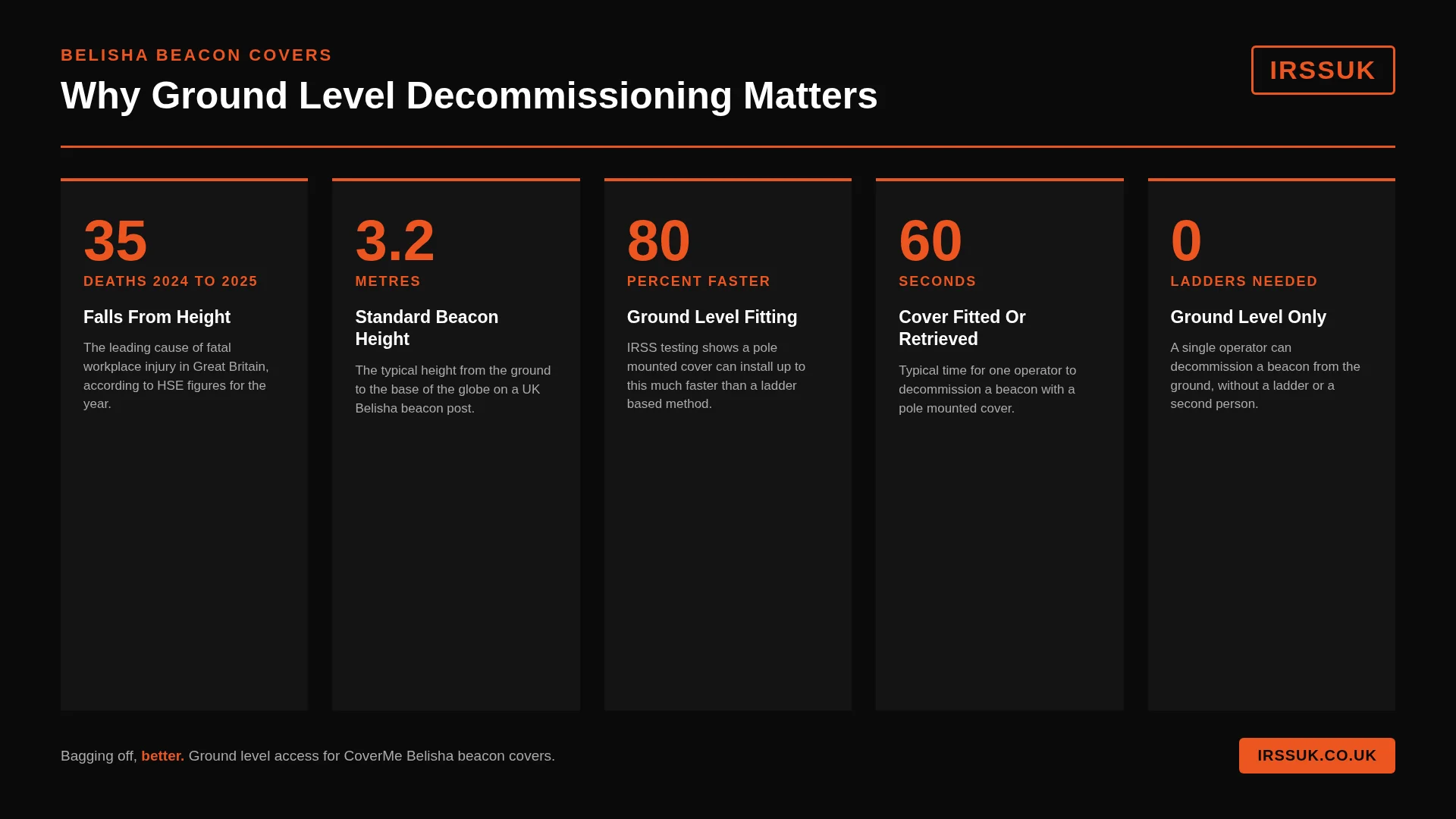
The ladder adds the second risk. Falls from height remain the leading cause of fatal workplace injuries across Great Britain. The Work at Height Regulations 2005 require that height work is avoided wherever it is reasonably practicable to do so. When a ground-level alternative exists, the use of a ladder is difficult to defend in any risk assessment.
What types of traffic light covers are available
The UK market now offers several categories of traffic light cover, ranging from improvised site materials through to purpose-engineered, patented systems. Understanding the difference matters for compliance, site efficiency, and legal defensibility.
Improvised covers
Bin bags and plastic film still appear on some sites. They offer no standardised fit, no opacity guarantee, and no reliable wind resistance. They require ladder access for installation on most UK signal head heights. ARTSM guidance identifies them as a risk factor rather than a solution.
Fitted fabric covers
Manufactured to fit specific signal head profiles, fabric covers improve on improvised solutions by providing a more reliable seal and better opacity. However, most fitted fabric covers still require ladder or MEWP access for installation, meaning they address the product quality problem without resolving the working at height risk.
Ground-level extension pole systems
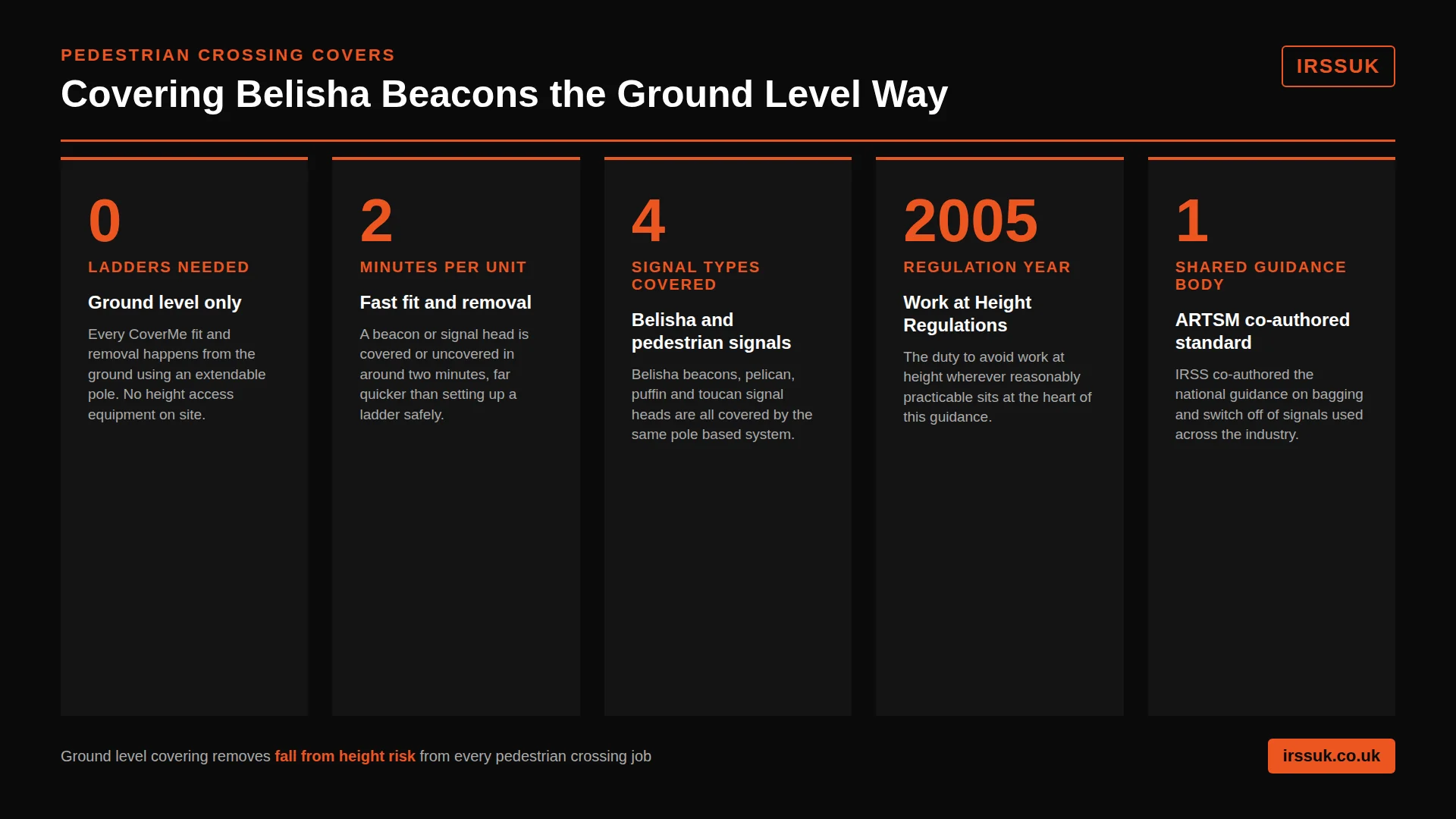
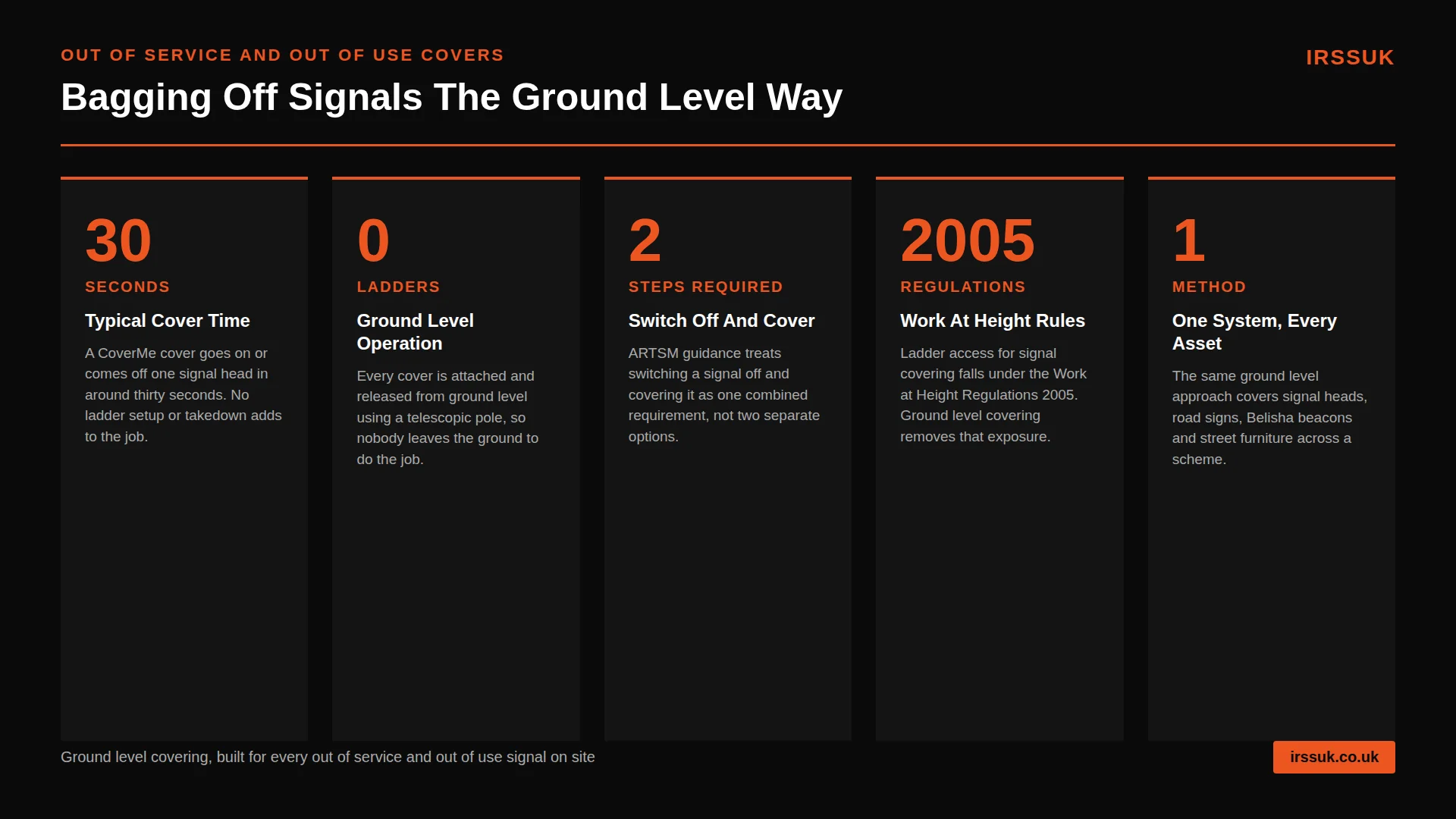
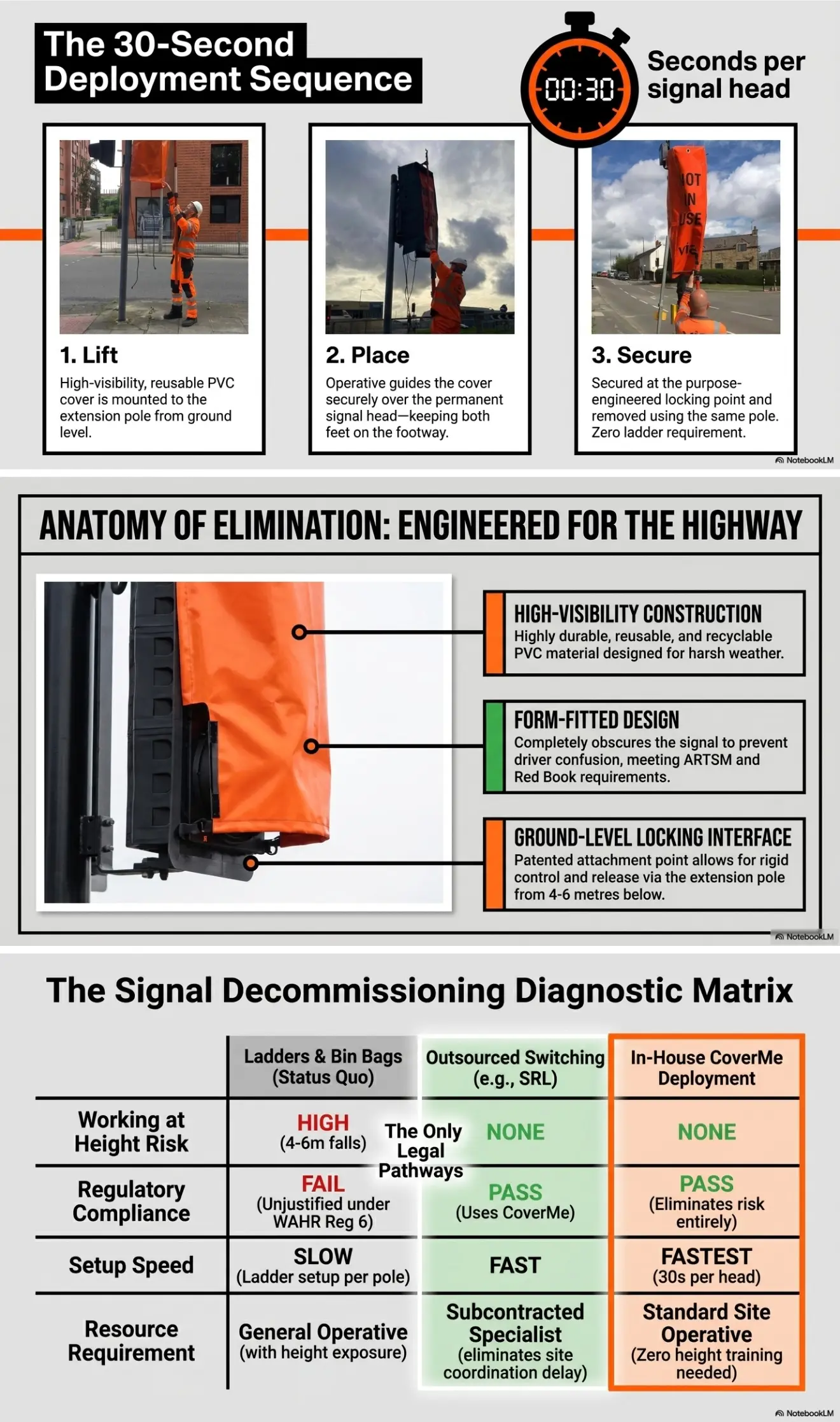
CoverMe traffic light covers from IRSS UK were designed specifically to eliminate ladder access entirely. The system uses a patented extension pole mechanism that allows a single operative to fit a purpose-made PVC cover over a signal head at 4 to 6 metres height from a standing position on the ground. No ladder. No MEWP. No IPAF certification required.
Peter Hoban, founder of IRSS UK, developed the CoverMe system after 25 years working in the traffic management industry. In real-world deployment, the system has reduced signal head covering time from approximately 3 minutes per head to around 30 seconds.
.jpg)
What the regulations require
Chapter 6 of the Traffic Signs Manual 2019 requires all signal equipment not in use to be bagged or clearly marked. Bags must be opaque enough to prevent signal aspects showing through when the equipment is lit. This is the baseline legal requirement that applies to every scheme.
The Work at Height Regulations 2005 require that work at height is avoided wherever reasonably practicable. The hierarchy of control places avoidance at the top, above prevention and above mitigation. Where a ground-level bagging system achieves the same outcome as a ladder-based approach, the hierarchy requires avoidance to be used.
CDM Regulations 2015 place a duty on Traffic Management Designers to eliminate foreseeable risk at the design stage. Specifying a ground-level bagging method from the outset satisfies that duty before operatives arrive on site.
Comparing bagging-off approaches
FactorBin bags and tapeFitted fabric coversCoverMe ground-level systemWorking at height requiredYes (ladder)Usually (ladder or MEWP)NoIPAF or ladder training neededYesYesNoOpacity complianceNot guaranteedUsually compliantFully compliantWind resistancePoorModerateHighSetup time per head3 min+3 min+~30 secondsReusableNoYesYesWAH Regs 2005 defensibilityWeakPartialStrongARTSM guidance compliantNoPartialYes
The full CoverMe product range
The CoverMe range has expanded beyond traffic signal heads to cover the full spectrum of street furniture that requires bagging off on UK schemes. The full range is available at irssuk.co.uk/products.
Product Application Installation method:
CoverMe Traffic Light Covers. Permanent signal heads during roadworksGround level via extension pole
CoverMe Road Sign Covers. Road and rail signs during maintenance. Ground level via extension pole
CoverMe Belisha Beacon Covers Zebra crossing beacons not in use. Ground level.
CoverMe Street Lighting Covers. Street lighting columns during works. Ground level
CoverMe Street Furniture Covers. Bollards, push buttons, other furnitureGround level
Real-world results
IRSS UK case studies document the practical outcomes across a range of scheme types. Siemens, deploying CoverMe covers on a Birmingham rail scheme, reported that the system allowed operatives from the wider highways pool to be used without any requirement for ladder training. Setup time reduced from approximately 3 minutes per signal head to around 30 seconds with the CoverMe extension pole system.
.png)
Use the CoverMe calculator to estimate how many covers your next scheme will need.
Comparing bagging-off approaches
FactorBin bags and tapeFitted fabric coversCoverMe ground-level systemWorking at height requiredYes (ladder)UsuallyNoIPAF or ladder training neededYesYesNoOpacity complianceNot guaranteedUsually compliantFully compliantWind resistancePoorModerateHighSetup time per head3 min+3 min+~30 secondsReusableNoYesYesWAH Regs 2005 defensibilityWeakPartialStrongARTSM guidance compliantNoPartialYes
Common questions about traffic light covers
Are traffic lights legally required to be covered during roadworks?
Yes. Chapter 6 of the Traffic Signs Manual 2019 requires all signal equipment not in use to be bagged over or clearly marked as out of use. Failing to bag off signals, or doing so inadequately, exposes the contractor and works promoter to liability for any resulting incident.
Can bin bags be used to bag off traffic signals?
The regulations require that covers are sufficiently opaque so that signal aspects do not show through. Bin bags cannot reliably guarantee this. The ARTSM guidance specifically identifies improvised plastic film covers as inadequate practice.
Do you need to be IPAF certified to use CoverMe covers?
No. The CoverMe system is designed to be used from ground level with an extension pole, requiring no ladder or MEWP access. Operatives do not need IPAF certification or ladder training, which widens the pool of personnel available on any scheme.
Does the CoverMe system satisfy the Chapter 6 opacity requirement?
Yes. CoverMe traffic light covers are manufactured from opaque PVC designed to prevent signal aspects showing through when equipment is lit.
What happens if a traffic signal is not properly bagged off?
Road users and pedestrians may act on signals that are no longer operational. Legally, inadequate bagging constitutes a failure of the works promoter and contractor duty of care, with liability for any resulting incident falling on the responsible parties.
The key takeaway
Bagging off traffic signals is a legal requirement on every UK roadworks scheme involving permanent signal decommissioning. Purpose-made ground-level systems now exist that are faster, safer, fully compliant with ARTSM guidance and WAH regulations, and reusable across multiple deployments. Speak to the IRSS UK team to discuss the right specification for your next scheme.
About the author: Peter Hoban is the founder of IRSS UK and inventor of the patented CoverMe system. With over 25 years of experience in traffic management and road safety, Peter co-authored the ARTSM national best practice guidance on bagging off traffic signals. He is a Safer Highways Big Idea finalist and a recognised authority on working-at-height elimination in the highways industry.