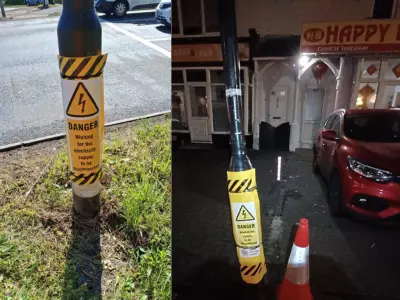
Street lighting maintenance safety starts with a simple principle: keep operatives on the ground. IRSS lantern and column covers deploy from ground level in under 60 seconds — no ladders, no MEWPs, no additional traffic management for the covering task.
The safest way to cover a street light lantern is from the ground. Traditional methods — a ladder against the column or a MEWP in the carriageway — expose operatives to fall risk and passing traffic for a task that takes minutes.
With millions of lighting columns across the UK and major LED upgrade and column replacement programmes under way, that routine exposure adds up across every authority’s network. This page explains when lanterns need covering, why ladders and MEWPs are a poor fit for the job, and how ground-level covering works.
Lanterns sit at the top of columns typically 5 to 12 metres tall. Any task that touches the lantern — covering it during commissioning, isolating it during works, marking it out of service — has traditionally meant an operative leaving the ground.
HSE figures for 2024/25 record 35 worker deaths from falls from height in Great Britain — 28% of all workplace fatalities and the largest single cause. Street lighting adds its own hazards: columns on verges and cambered footways, works alongside live traffic, and night-time working.
The Work at Height Regulations 2005 require duty holders to avoid work at height wherever a reasonably practicable alternative exists — and for covering tasks, one now does. Learn more about working at height in traffic management.
Each of these is a short-duration task — exactly the kind where full MEWP mobilisation is disproportionate, and where ladder use is hardest to justify.
Fall risk. Two operatives needed for footing. Unstable on verges and cambered footways. Slow across a programme of columns. Difficult to justify under the Work at Height Regulations 2005.
Hire and mobilisation cost. Usually needs traffic management or a lane closure. Requires a driver and a trained operator. Disproportionate for a task that takes minutes. Availability can delay programmes.
One operative. Under 60 seconds per lantern. No fall risk, no MEWP hire, typically no additional traffic management. Reusable covers replace single-use plastic.
For a 60-second covering task, both traditional options cost far more in time, money and risk than the task itself warrants.
CoverMe street lighting covers fit over the lantern using a telescopic pole operated entirely from the ground. One operative positions the cover, extends the pole, seats the cover over the lantern, and withdraws — typically in under 60 seconds. Removal is just as fast.
No climbing, no MEWP, and usually no additional traffic management. Covers are reusable across hundreds of deployments, replacing the single-use plastic sheeting and tape of traditional bagging off.
In HSE hierarchy-of-control terms, this sits at the top: the fall risk is not managed — it is eliminated, because nobody leaves the ground.
See how UK authorities and contractors use ground-level covering in practice:
With a pole-deployed cover: a reusable cover seated over the lantern using a telescopic pole from ground level. Deployment takes under 60 seconds and removal is just as fast, with no climbing and typically no additional traffic management.
New columns are covered between installation and adoption so residents, drivers and network teams know they are not yet in service. Covering also prevents confusion during phased LED upgrade programmes and marks faulty lanterns awaiting repair.
No. A MEWP is only needed if the task itself requires working at the lantern. For covering and uncovering, a ground-level pole system removes the need for a MEWP, its hire cost, and the traffic management that goes with it.
The Regulations require work at height to be avoided where reasonably practicable. For covering tasks a ground-level alternative exists, so duty holders are expected to use it; ladders remain justifiable only where no such alternative is practicable.
SUPPORTING ARTICLES PLACEHOLDER — future content: LED Upgrade Programmes and Covering · Lighting Column Risk Assessment · Commissioning Best Practice
Talk to IRSS about commissioning, LED upgrade or column replacement schemes — or calculate what ground-level covering could save you.
Sources: HSE work-related fatality statistics 2024/25 · HSE work at height guidance · Work at Height Regulations 2005 (legislation.gov.uk)
.svg)