Belisha beacon regulations in the UK sit within the Traffic Signs Regulations and General Directions 2016, which set out how zebra crossings and their beacons must look and work. A zebra crossing has a flashing beacon at each end, and drivers must give way to pedestrians on it. IRSS UK, co-authors of ARTSM guidance on bagging off, explains what the rules mean for highways teams.
What the Regulations Say
Belisha beacons have marked zebra crossings since 1934. They are named after Leslie Hore-Belisha, then Minister of Transport. The flashing amber globe on a black and white striped post tells drivers that a crossing is ahead.
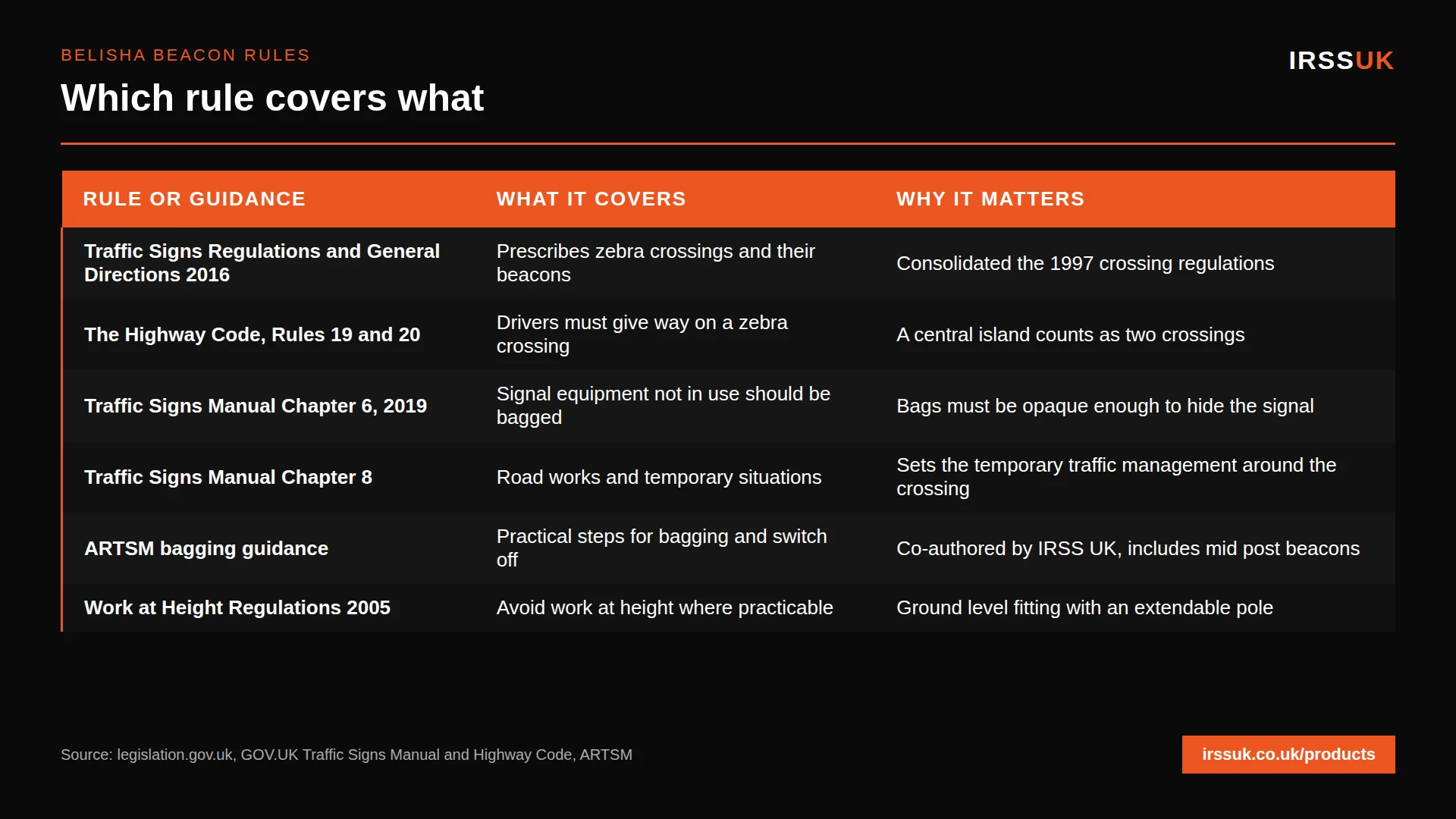
Today the rules sit in the Traffic Signs Regulations and General Directions 2016. That instrument consolidated the older Zebra, Pelican and Puffin Pedestrian Crossings Regulations and General Directions 1997, which are now revoked. Older articles and specifications still cite the 1997 regulations, so check which version applies.
In practice, a zebra crossing has a beacon at each end. A central island is treated as two separate crossings.
Rules for Drivers and Pedestrians
The Highway Code notes that zebra crossings have flashing beacons. Rule 19 says drivers and riders must give way to pedestrians on a zebra crossing. It also reminds pedestrians that traffic does not have to stop until someone has moved onto the crossing.
Rule 20 treats a zebra crossing with a central island as two separate crossings. Pedestrians must wait on the island and follow Rule 19 again before crossing the second half.
What Applies When a Beacon Is Out of Use
A beacon that is not working, or a crossing that is being decommissioned or worked on, must not mislead road users. The Department for Transport's Traffic Signs Manual sets the standard here. Chapter 6 (2019) states that signal equipment not in use should be bagged, and that bags must be opaque enough for the signal not to show through.
Chapter 8 covers the temporary traffic management around the works. The ARTSM Guidance on Bagging and Switch Off of Signals, co-authored by IRSS UK, turns these requirements into practical steps for contractors.

Top Post and Mid Post Beacons
Most beacons have the globe at the top of the post. Some designs place the globe partway down the post, often integrated with a lighting column or fixed with a clamp. Newer ARTSM guidance addresses mid post beacons directly, because the traditional ladder approach is awkward at a live crossing on a busy footway. Our mid post beacon guide explains the changes.
Working at Height and Belisha Beacons
Covering a beacon on a top post traditionally means a ladder. The Work at Height Regulations 2005 require employers to avoid work at height where it is reasonably practicable to do so. The CoverMe Belisha beacon cover is fitted and removed from ground level with an extendable pole, so the operator does not need to climb. Read the CoverMe Belisha Beacon Covers page or the Hatton Belisha beacon scheme for an example.
A Quick Checklist for Out of Use Beacons
- Confirm which beacon type is on site: top post or mid post.
- Set up temporary traffic management to Chapter 8 before work starts.
- Use a fully opaque cover so the globe cannot be seen through it, including at night.
- Fit and remove the cover from ground level wherever practicable.
- Record the date covered and the date the crossing returns to service.
Common Questions
Does every zebra crossing need Belisha beacons?
Zebra crossings in Great Britain have a flashing beacon at each end. The beacon requirements are set within the Traffic Signs Regulations and General Directions 2016, so confirm the detail with your highway authority for a specific crossing.
Why is it called a Belisha beacon?
It is named after Leslie Hore-Belisha, the Minister of Transport who introduced the beacons at pedestrian crossings in 1934.
Do Belisha beacons have to be covered when a crossing is out of use?
The Traffic Signs Manual says signal equipment not in use should be bagged, with bags opaque enough that the signal does not show through. An uncovered beacon can still look live to a driver, especially at night.
Can you cover a Belisha beacon without a ladder?
Yes. The CoverMe Belisha beacon cover is fitted from ground level with an extendable pole. That removes the need for ladder access to the beacon globe.
Why It Matters
Beacons exist so drivers recognise a crossing at a glance. A covered, opaque beacon sends a clear message that the crossing has changed status. An uncovered one that is not flashing sends a confusing message at exactly the wrong moment.
Following the Traffic Signs Manual and ARTSM guidance also protects contractors and authorities if an incident is investigated.
The Takeaway
Know which regulations apply, follow the Traffic Signs Manual for equipment not in use, and avoid working at height where you can. For a ground level solution, see CoverMe Belisha Beacon Covers or contact IRSS UK.