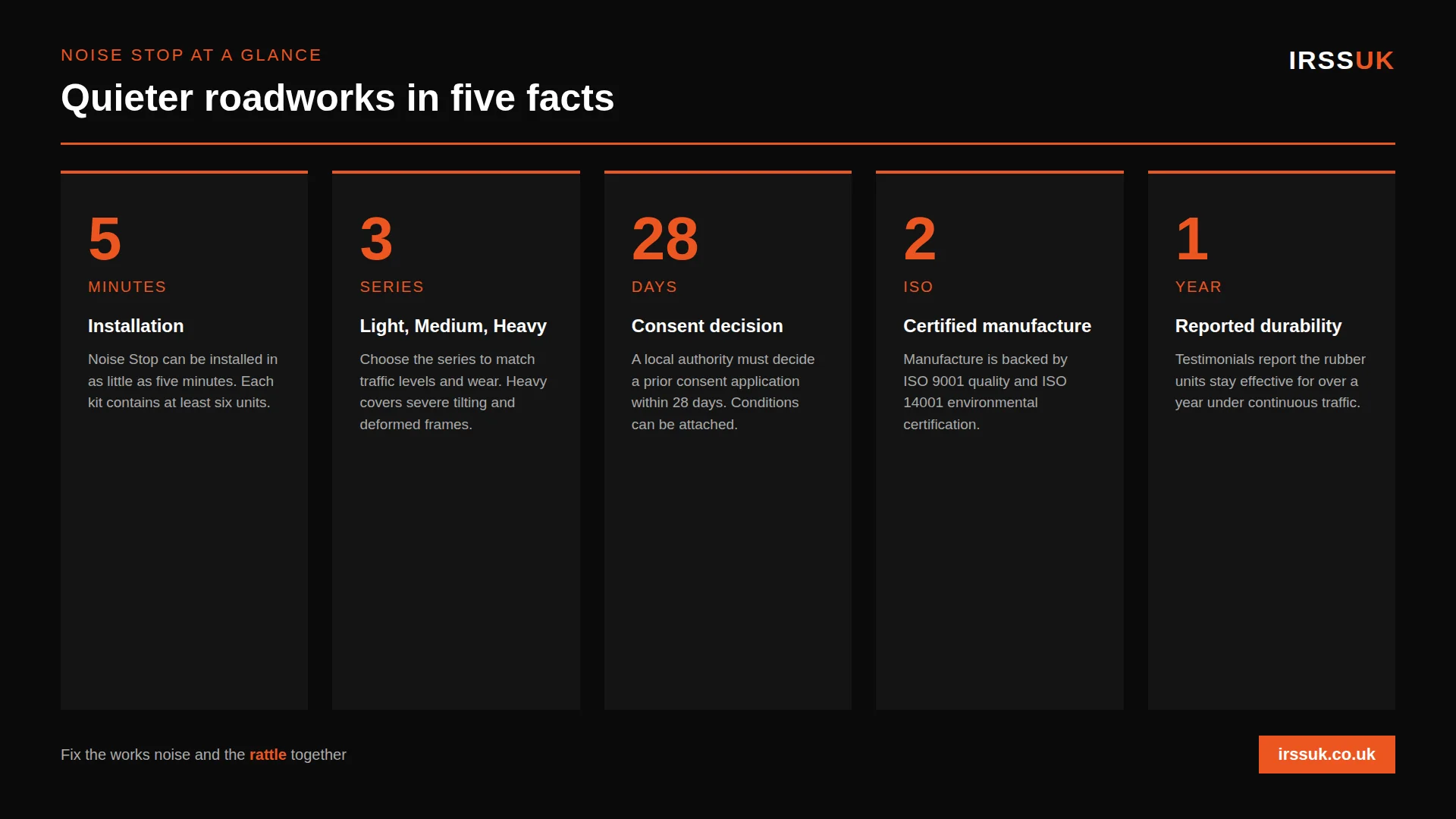
To cover a Belisha beacon during roadworks, get the highway authority's approval to take the zebra crossing out of use, then fit a fully opaque cover over each beacon globe. Put up "crossing not in use" signs and barriers, and record when the beacons were covered and uncovered.
This guide is for contractors, traffic management teams and councils planning a crossing closure. IRSS UK, co-authors of the ARTSM guidance on bagging and switch off of signals, compares the covering methods, what drives the cost and what the guidance expects.
How to Cover a Belisha Beacon: The Short Answer
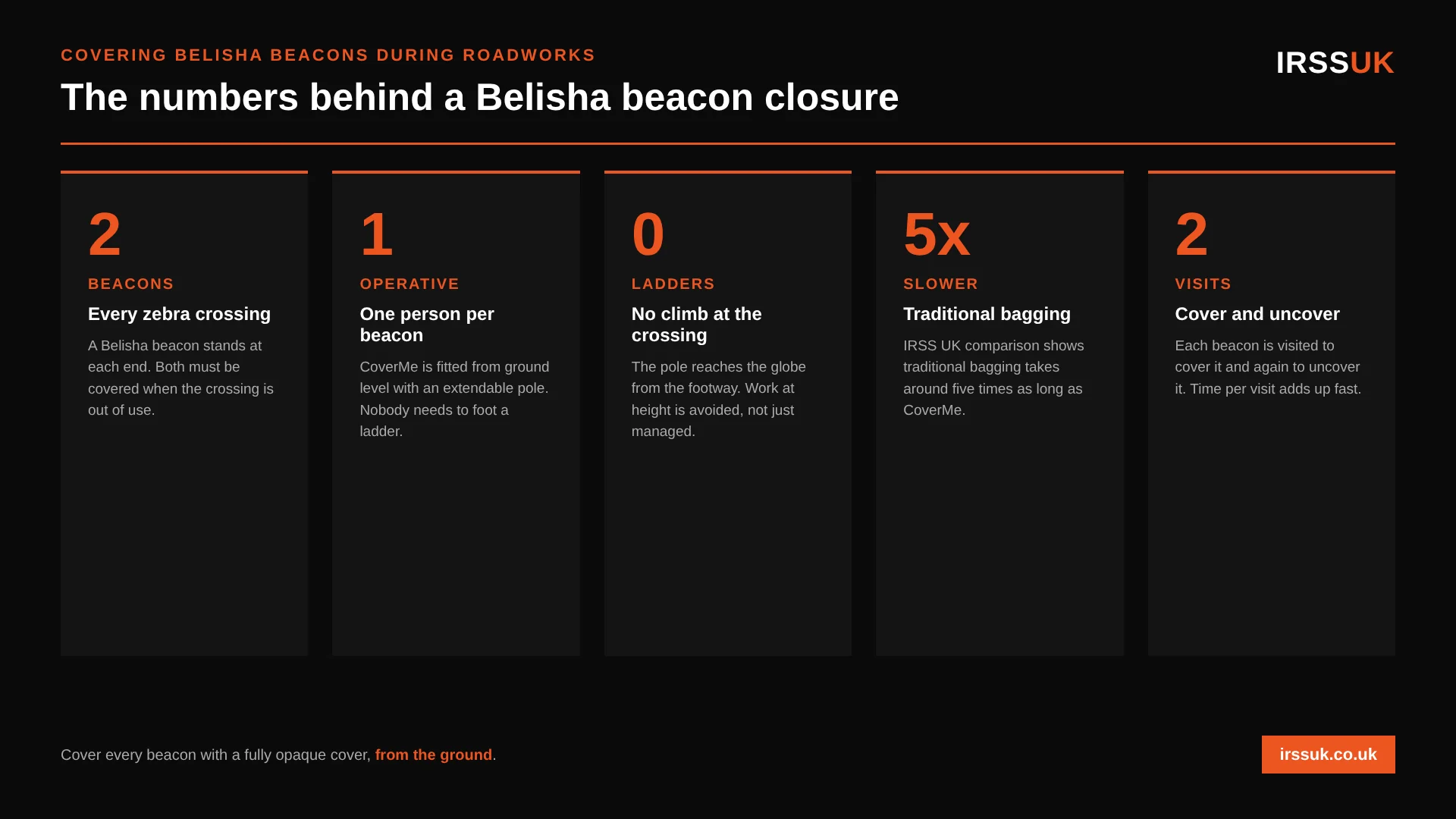
Here's the reality on site. A zebra crossing has a Belisha beacon at each end, and both must be covered when the crossing is out of use.
- Get authorisation first. Only the highway authority can authorise taking a crossing out of service.
- Use a suitable, opaque cover. The globe must not show through, including at night if the beacon stays lit.
- Cover every beacon on the crossing. Where there's a central refuge, close and cover both halves.
- Sign and barrier the crossing. "Crossing not in use" signs and barriers stop pedestrians walking out.
- Avoid the ladder where you can. Fit the cover from ground level if a practical method exists.
What the Guidance Requires
The rules come from several places, and they all point the same way.
The Traffic Signs Manual Chapter 6 says signal equipment not in use should be bagged over or clearly marked as out of use. It also says bags should be opaque enough that lit aspects don't show through.
HAUC(UK)'s bulletin on closing pedestrian crossing points is blunter. Zebra crossing globes must be covered with suitable covers, not things like black bin liners. The bulletin also says to close a crossing only when you have to, and to agree alternative arrangements with the highway authority first.
The ARTSM Guidance on Bagging and Switch Off of Signals, which IRSS UK co-authored, turns these requirements into practical steps for contractors. Read our Belisha beacon regulations guide for the wider rules on zebra crossings and the Highway Code.
Belisha Beacon Covering Methods Compared
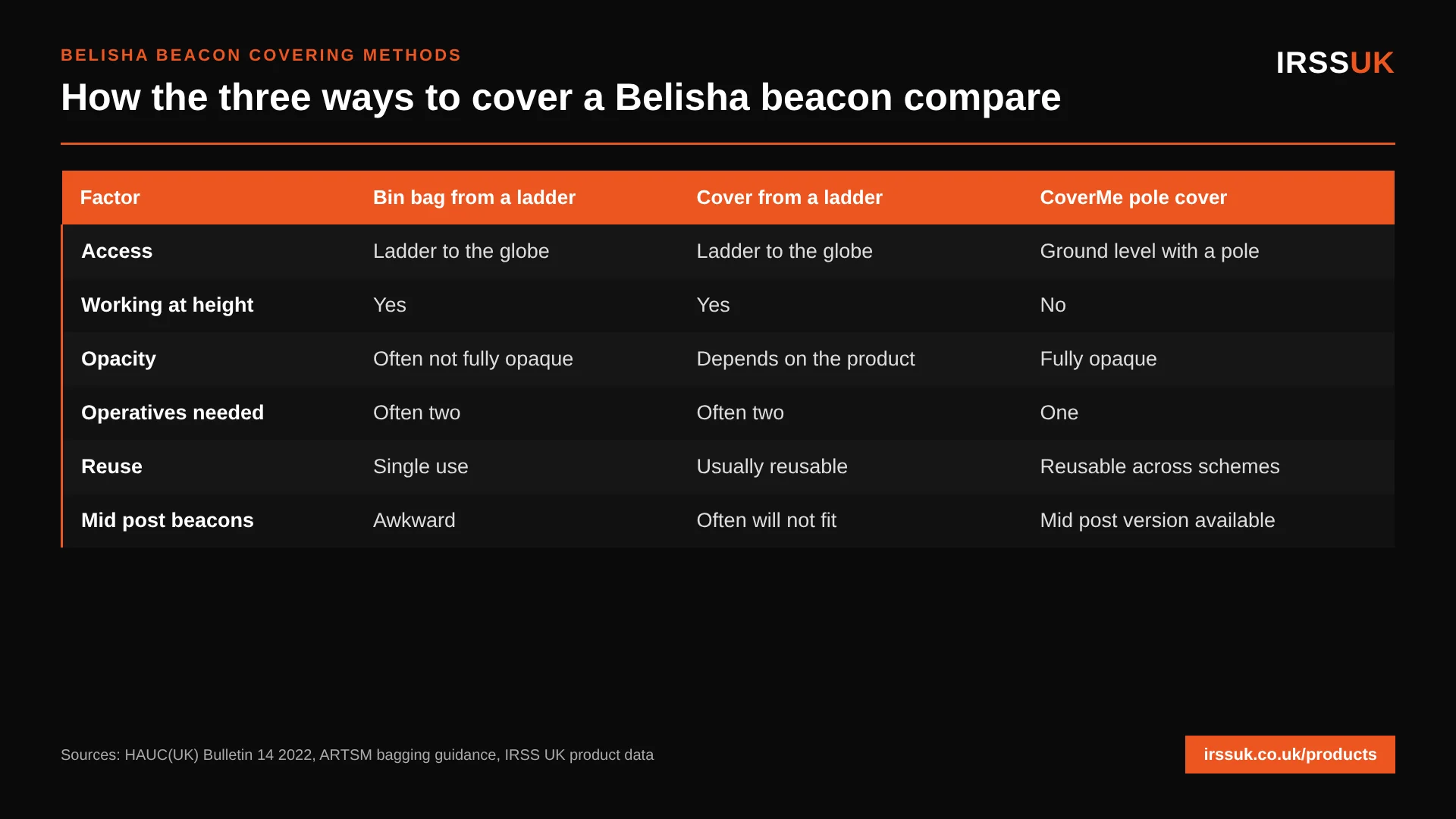
Most teams still use one of three methods. Here's how they compare.
Bin bags are cheap on paper. The problem is they often let light through overnight, and they can become displaced on exposed crossings. HAUC(UK) guidance names them as unsuitable.
Covers fitted from a ladder solve opacity but keep the climb. On a busy footway, a ladder at a live crossing puts the operative and pedestrians at risk.
CoverMe Belisha Beacon Covers are fitted and removed from ground level by a single operative using an extendable pole. There's no ladder, no ladder training and no climb. A dedicated cover is available for mid post beacons, where the globe sits partway down the post.
See how this works in practice in the Hatton Belisha beacon scheme on HS2.
What Covering Belisha Beacons Really Costs
The price of the cover is the smallest part of the bill. What matters is the cost per beacon, per visit, across the whole scheme.
- Crew size. Ladder work often needs a second operative to foot the ladder. A pole method needs one.
- Training. Ladder work needs trained operatives. Ground level fitting opens the job to the wider highways pool.
- Time per beacon. IRSS UK's comparison shows traditional bagging takes around five times as long as CoverMe.
- Repeat visits. Every beacon is covered once and uncovered once. Displaced bags mean extra call-outs.
- Waste. Single-use bags are binned after every scheme. Reusable covers carry over to the next job.
Multiply those by every beacon on the scheme. A two-crossing closure is four beacons and eight visits before anything goes wrong. Use the CoverMe calculator to work out the saving for your own schemes.
Your Method Statement Checklist
Put these points into the method statement and risk assessment before work starts:
- Highway authority authorisation, with dates covering the full works period.
- Alternative crossing arrangements agreed with the authority, including any temporary crossing.
- Beacon type on each post: top post or mid post.
- Covering method, and why it avoids working at height where reasonably practicable.
- Signs, barriers and pedestrian routes, walked and checked before closure.
- A record of when each beacon was covered and uncovered.
The Work at Height Regulations 2005 require employers to avoid work at height where it is reasonably practicable. A ground level method makes that an easy box to tick.
Common Questions
Can you use bin bags to cover a Belisha beacon?
It's not recommended. HAUC(UK) guidance says zebra crossing globes should be covered with suitable covers, not black bin liners, because bags are often not opaque and can become displaced.
Who can authorise a zebra crossing to be taken out of use?
Only the highway authority. Agree the dates and any alternative crossing arrangements with them before you cover the beacons.
Do Belisha beacons have to be covered if they are switched off?
The Traffic Signs Manual says equipment not in use should be bagged or clearly marked as out of use. An unlit but uncovered beacon can still look like a working crossing, so covering the globe makes the change clear.
How do you cover a mid post Belisha beacon?
Use a cover designed for the mid post layout. IRSS UK makes a dedicated CoverMe Belisha Beacon Cover for mid post beacons, fitted from ground level with the same pole.
Why Getting It Right Matters
A crossing that looks live but isn't is a real hazard. A driver may not expect pedestrians, and a pedestrian may step out expecting traffic to stop.
Getting the cover, signs and records right also protects your team if an incident is investigated. Following the Traffic Signs Manual, HAUC(UK) and ARTSM guidance shows you planned the closure properly.
The Key Takeaway
Get authorisation, cover every beacon with a fully opaque cover, and sign the crossing as not in use. Fit the covers from ground level to remove the ladder and cut the time per beacon.
CoverMe Belisha Beacon Covers have been supplied to Waterman Aspen, Route 1 Traffic Management and Clancy. See the full CoverMe Belisha Beacon Covers product or speak to our team for a quote for your beacon count.